
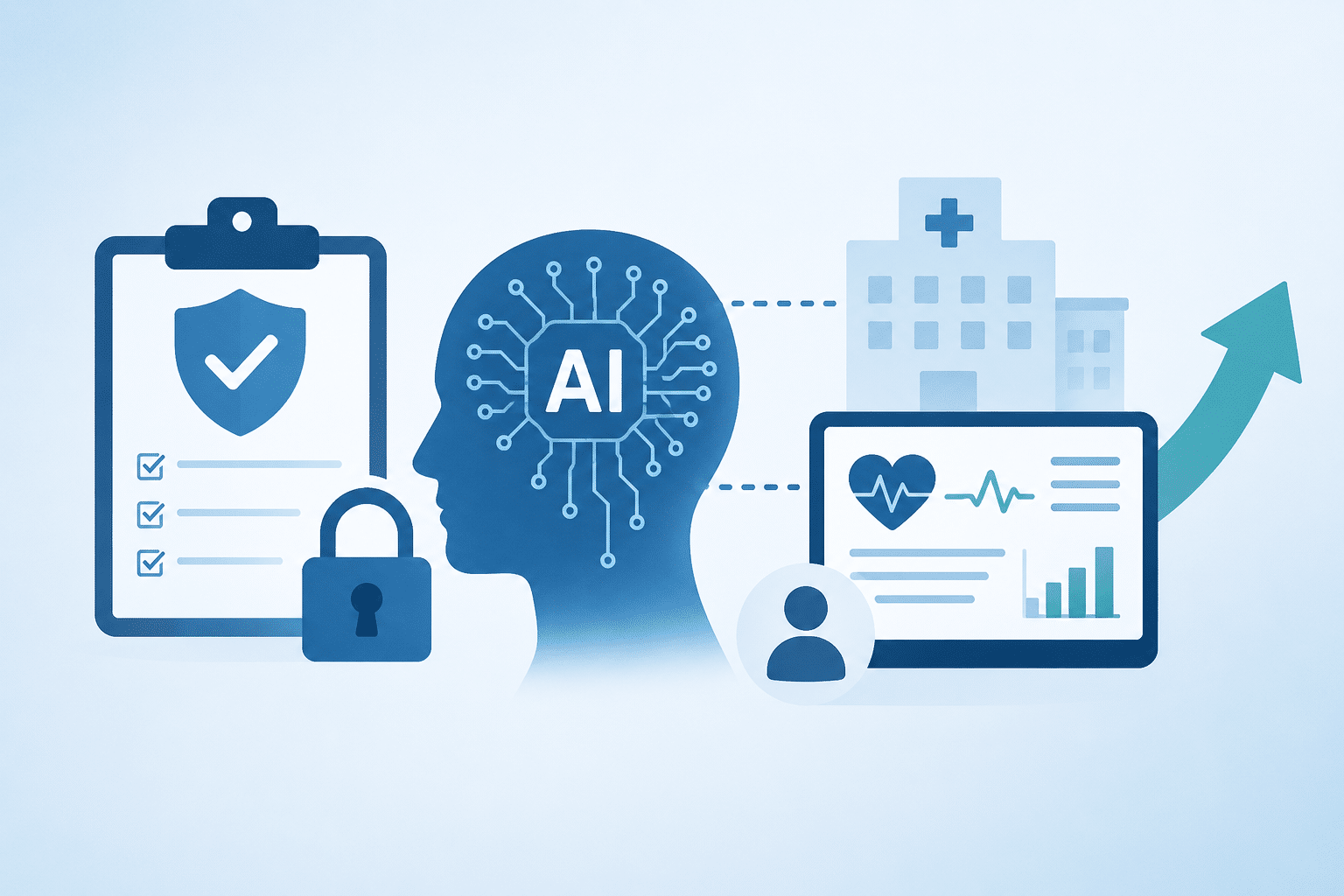
Artificial intelligence in healthcare has moved past the hype cycle. Hospitals no longer ask “should we use AI?” — they ask “which AI actually reduces readmissions, cuts documentation time, or catches a deteriorating patient before it’s too late?” The gap between flashy AI demos and dependable clinical deployment is where most projects stall. Success in 2025 rests on three pillars: Compliance, Integration, and Outcomes. This is a practical roadmap for CIOs, product managers, and clinical leads who need proof, not promises, before greenlighting an AI investment. The Operational AI Stack: Features That Fix the Front and Back Office Before AI touches a diagnosis, it should fix the operational bottlenecks draining staff time and revenue. These are the highest-ROI, lowest-risk entry points for most health systems. Predictive Scheduling & Capacity Management Machine learning models trained on historical admission patterns, seasonality, and local event data can forecast ER surges and optimize OR block scheduling. Predictive no-show algorithms that factor in weather, transportation access, and patient history have been shown to reduce no-shows by up to 30% when paired with automated reminder workflows. Intelligent Patient Portals NLP-powered chatbots now handle appointment booking, prescription refill requests, and pre-visit intake questionnaires — reducing front-desk call volume and improving data quality before the patient even arrives. Revenue Cycle Automation AI applied to prior authorization, claims scrubbing, and denial management can flag coding errors before submission, shortening the revenue cycle and reducing costly rework for billing teams. Ambient Clinical Intelligence (AI Scribes) Ambient documentation tools listen to patient-clinician conversations and generate structured notes automatically. This directly targets physician burnout — one of the most measurable and immediate wins available to health systems today. The Clinical AI Stack: Features That Improve Diagnosis and Treatment Once operational foundations are stable, clinical AI delivers the next layer of value — but with a much higher bar for validation. Medical Imaging Triage AI models trained on large annotated imaging datasets can flag time-critical findings — such as intracranial hemorrhage or pulmonary embolism — and push them to the top of a radiologist’s queue, shrinking time-to-diagnosis for the sickest patients. Clinical Decision Support (CDS) Apps CDS tools generate real-time alerts for drug-drug interactions, sepsis risk scores, and early signs of patient deterioration. When integrated correctly, they act as a second set of eyes rather than another alert clinicians learn to ignore. Genomic & Precision Medicine AI-assisted variant interpretation accelerates the translation of genomic sequencing into actionable treatment matching, particularly in oncology, where time-to-therapy decisions matter. Remote Patient Monitoring (RPM) Wearable and home-device data streams feed models that predict exacerbations in chronic conditions like COPD and congestive heart failure — enabling intervention days before a hospital visit becomes necessary. The Compliance Prerequisite: Why HIPAA Is Your First Feature No feature list matters if the underlying system can’t be trusted with protected health information (PHI). Compliance isn’t a checkbox added at the end — it’s the architecture the entire application is built on. HIPAA Compliance Is Non-Negotiable Any AI vendor touching PHI needs a signed Business Associate Agreement (BAA), enforced encryption at rest and in transit, and granular, role-based access controls. This is table stakes, not a differentiator. The Cloud Security Trap Generic public AI tools frequently pose hidden risks: unclear data residency, ambiguous retention policies, and — critically — the possibility that PHI submitted to a consumer-grade model gets used in future training runs. Healthcare organizations should demand explicit contractual guarantees against this. Model Explainability (XAI) A “black box” recommendation is a liability in a clinical setting. Techniques like SHAP and LIME allow clinicians and auditors to see why a model flagged a patient as high-risk, which is essential for both trust and legal defensibility. Audit Trails Every AI-driven decision — from a triage recommendation to a denied claim — must be logged with timestamp, model version, and input data reference, ready for regulatory review at any time. How to Build an AI-Powered Clinical Decision Support App (Step-by-Step) Building a CDS application is less about picking a fancy model and more about disciplined scoping and validation. Here’s the realistic sequence. Step 1 — Define the Clinical Problem Narrow scope wins. “Improve patient outcomes” is not a build spec; “predict sepsis onset in ICU patients within a 4-hour window” is. A tightly defined problem statement determines every downstream decision, from data requirements to success metrics. Step 2 — Data Curation & Labeling This is the hardest and most underestimated step. Clean, de-identified EMR data, properly labeled by clinical experts, is the true bottleneck of most healthcare AI projects — not the algorithm itself. Poor data quality here guarantees poor model performance later, regardless of architecture. Step 3 — Model Selection & Training Start simple. Logistic regression and gradient-boosted trees (like XGBoost) are often more interpretable and just as accurate as deep learning for many structured-data problems. Benchmark performance using standard clinical ML metrics such as AUROC and F1 score, and always compare against the existing clinical standard of care — not just against a theoretical baseline. Step 4 — Integration with EHR (HL7/FHIR) A model that isn’t embedded in the clinician’s existing workflow will be ignored. Integration via HL7 FHIR and SMART on FHIR standards allows the CDS tool to plug directly into Epic, Cerner, or other major EHRs, surfacing alerts inside the chart the clinician is already reviewing. Step 5 — Validation & Deployment Prospective validation in a sandboxed “shadow mode” — where the model runs silently alongside clinical decision-making without influencing it — is essential before any live rollout. This step catches performance drift and false-positive fatigue before they affect real patients. Companies like Taction software, which build HIPAA-compliant healthcare software and manage EHR interoperability projects for hospitals and digital health startups, typically treat this validation phase as non-negotiable before go-live, precisely because skipping it is where most CDS pilots quietly fail. How to Choose the Best AI Healthcare Software Development Company in the US With hundreds of vendors claiming “AI-powered” capabilities, evaluation criteria matter more than marketing claims. Criteria 1
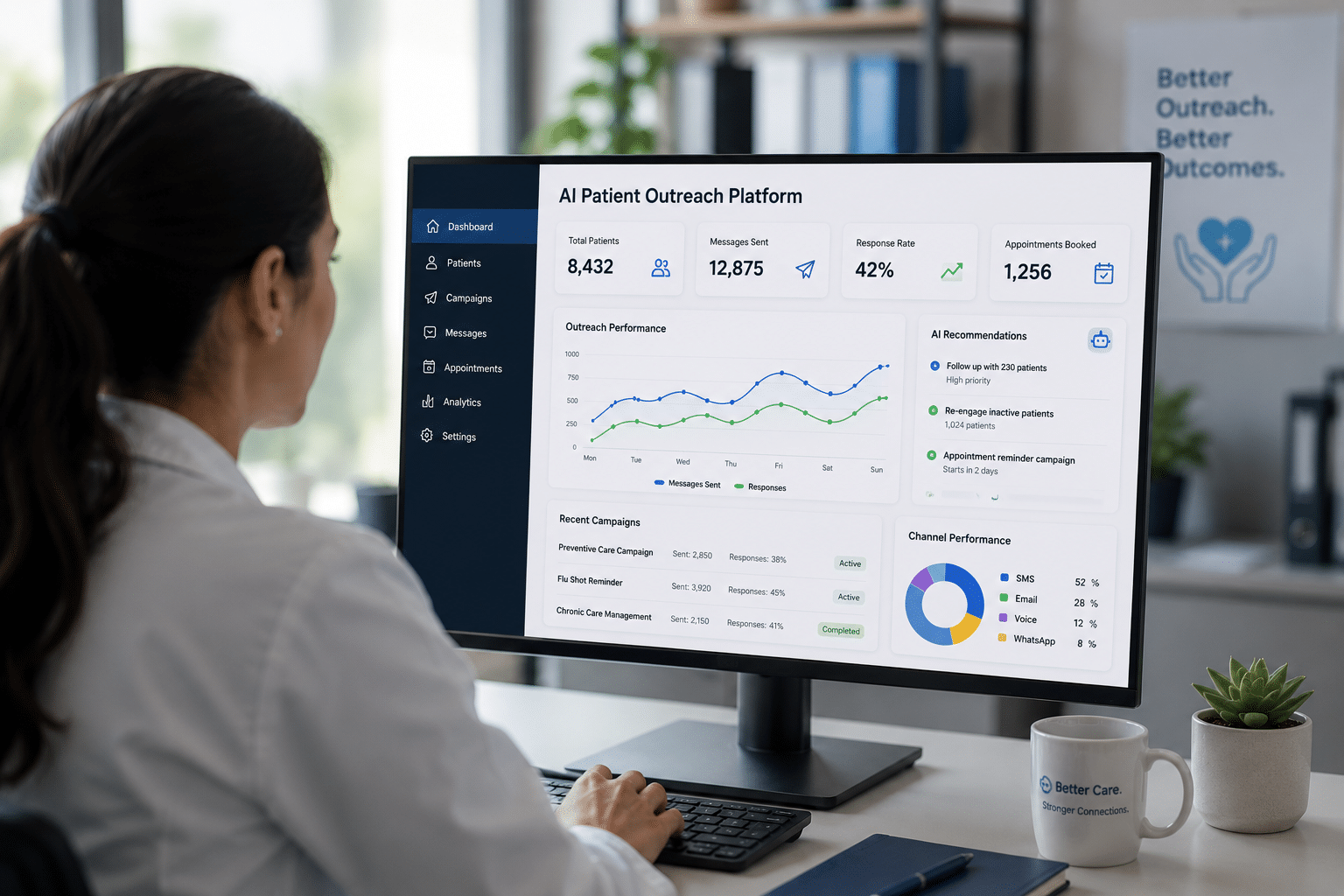
An AI patient outreach platform helps you reach patients proactively and at scale — sending the right message to the right person at the right time, through the channels they actually use. It watches for the moments that call for outreach (an upcoming appointment, an overdue screening, a recent discharge, an open care gap), works out who needs to hear from you and about what, personalizes the message, and can even handle simple back-and-forth replies — while handing anything clinical or urgent to your staff. The goal is plain: fewer missed appointments and missed care, less manual phone tag for your team, and patients who feel looked after. You stay in control of what gets sent, to whom, and when. The patients who need a nudge are the ones you can’t reach by hand A lot of good care depends on a patient doing something outside the visit — coming in for the annual screening, picking up where they left off after a discharge, rebooking the appointment they cancelled, following through on a referral. The trouble is that reaching everyone who needs that nudge, one phone call at a time, simply isn’t realistic. Your staff’s time is finite, the list is long, and so the outreach that actually happens ends up partial and reactive: the squeaky wheels get called, and a lot of other patients quietly slip through. You can see the result in the numbers most practices and health systems watch — no-shows, missed preventive care, gaps that never get closed, patients who drift out of the system and only reappear when something has gone wrong. None of that is for lack of caring; it’s a reach problem. There are only so many hours in the day for phone calls. The answer isn’t to make more phone calls. It’s to let software handle the routine, high-volume outreach — intelligently, personally, and at scale — so your team’s time goes to the conversations that genuinely need a human. That’s what an AI patient outreach platform is for. What an AI patient outreach platform does Here’s what a custom build typically handles, in plain terms. It knows who to reach, and why. Instead of someone building call lists by hand, the platform watches your systems for the triggers that matter — upcoming appointments, overdue or due-soon care, recent discharges, open care gaps — and assembles the outreach automatically, so the right patients surface without the manual work. It personalizes the message. A reminder for a routine check-up and a follow-up after a hospital stay are not the same conversation, and a one-size-fits-all blast tends to get ignored. The platform tailors the content, tone, and language to the reason for the outreach and to the person receiving it, so the message lands as relevant rather than generic. It meets patients where they are. Some people respond to a text, others to a call, an email, or a portal message. The platform reaches patients on the channel they prefer — and, importantly, respects their consent and their choice to opt out. It can handle the simple back-and-forth. For routine things — confirming, rescheduling, answering common questions — conversational AI can respond directly, which saves your staff a great deal of repetitive work. Anything clinical, sensitive, or urgent is handed off to a person rather than answered by software. It times things sensibly. Outreach sent at the wrong moment is wasted, or worse, annoying. The platform sends at the times most likely to get a response and an action — not in the middle of the night. It tracks what’s working. You can see who was reached, who responded, and who actually followed through, so outreach gets better over time instead of running blind. A quick note on what this is and isn’t: outreach is about reaching patients proactively. It’s not the same as a care coordination platform, which manages the care team and a patient’s whole journey, or a scheduling system, which books the visit itself, or no-show-specific tooling. Outreach works alongside those rather than replacing them, and we keep the boundaries clean so each does its own job well. How it connects to your systems For the platform to know who to contact and why, it has to read the signals in your systems — appointments, due and overdue care, discharges, and care gaps. We connect it to your EHR through our FHIR API development and HL7 integration services, and it works alongside your scheduling and patient-record systems rather than asking your team to maintain a separate list. This is one workflow within our AI solutions for healthcare practice, designed to plug into what you already run. Doing it responsibly: consent, privacy, and the clinical line Reaching out to patients carries real responsibilities, and we build for them from the start rather than bolting them on later. Three things matter most. First, consent and preference: patients have to have agreed to be contacted on a given channel, and opting out has to be easy and honored — the rules around texting and calling patients are not optional, and the platform is built to respect them. Second, privacy: messages can involve protected health information, so what’s sent, where, and how is handled with HIPAA in mind, under a signed BAA, with appropriate safeguards. Third, and most important, the clinical line: the platform handles logistics and simple questions, but it does not give medical advice on its own, and it is designed to route anything clinical, sensitive, or urgent to your staff with appropriate escalation. The aim is outreach that’s helpful and trustworthy — never outreach that oversteps. What it uses, and how it decides The platform works from the signals already in your systems — who has an appointment coming up, who’s overdue for something, who was recently discharged, where a care gap is open — plus each patient’s channel preferences and consent. Two principles guide how it behaves. First, its targeting is explainable: you can see why a given patient was
Artificial Intelligence in Healthcare Mobile App Development The healthcare industry is experiencing a transformation through (Artificial Intelligence) AI which boosts mobile application capabilities by improving diagnostic accuracy and streamlining clinical tasks while boosting patient interaction. AI transforms healthcare delivery and management through advanced symptom checkers and analytic tools as well as chatbots that support telemedicine services. Taction Software leverages 19 years of healthcare IT knowledge to develop AI-powered mobile healthcare applications that combine cutting-edge AI technology with practical medical needs. Our solutions enhance clinical efficiency and patient care while securing data to comply with HIPAA and other regulatory standards. This article examines AI’s impact on healthcare mobile app development by examining key technologies that drive these changes and discussing real-world applications while addressing challenges and future trends. This guide provides healthcare providers, startups, and enterprises looking to adopt AI with insights into the benefits of AI-powered healthcare mobile apps. Why AI is Revolutionizing Healthcare Mobile Apps? Despite widespread adoption in healthcare mobile applications users face persistent obstacles including inefficient patient management delayed diagnostics data security risks and insufficient personalization features. EHR system integration challenges plague many healthcare apps resulting in disjointed patient care and manual processing that delays treatment processes. The massive amount of healthcare data presents significant challenges in generating useful insights without utilizing advanced technological solutions. AI improves healthcare applications through better efficiency and accuracy while providing personalized care solutions. Machine Learning (ML) algorithms process substantial patient data volumes to produce real-time insights along with predictive diagnoses and customized treatment plans. AI chatbots deliver round-the-clock virtual support which helps shorten patient waiting periods and increases overall engagement. The Natural Language Processing (NLP) technology allows physicians to convert spoken clinical information into written documentation which saves them time. Key AI-driven features in healthcare mobile apps include: AI-powered symptom checkers for early diagnosis. Predictive analytics to detect potential health risks. Automated appointment scheduling for seamless patient flow. Remote patient monitoring (RPM) with AI-integrated wearables. AI-enhanced drug discovery and clinical decision support. Through the adoption of artificial intelligence technologies healthcare providers are able to offer more accurate data-based and widely accessible care which leads to improved patient results and enhanced operational effectiveness. How Healthcare Business Intelligence Is Improving Patient Care Harness the power of AI in healthcare mobile app development. Let’s create innovative, compliant, and intelligent solutions together! Get Started Key AI Technologies Powering Healthcare Mobile Apps The healthcare industry is experiencing a digital transformation as Artificial Intelligence brings advanced diagnostic tools to healthcare mobile apps with automation capabilities that tailor patient care. AI-powered innovations are defining the next stage of healthcare mobile application development. Machine Learning for Personalized Patient Care Machine Learning (ML) is revolutionizing predictive analytics while simultaneously improving patient monitoring and early diagnosis of diseases. Machine Learning algorithms analyze extensive patient data to detect patterns which allow them to forecast health risks before symptoms emerge. ML technology functions as a vital tool for chronic disease management by tracking diabetes and hypertension and offering individualized treatment solutions. ML-powered early diagnosis models enhance disease detection accuracy for conditions like cancer which results in fewer invasive diagnostic procedures. Natural Language Processing (NLP) in Virtual Assistants NLP technology allows chatbots and virtual assistants to manage patient interactions more effectively by enhancing response time while maintaining accessibility. Voice recognition software enabled by artificial intelligence enables doctors to transcribe medical notes without using their hands. Virtual assistants provide patient support through answering questions and scheduling appointments while also analyzing speech patterns to identify potential neurological conditions such as Alzheimer’s and Parkinson’s. Computer Vision in Medical Imaging & Diagnostics Medical imaging diagnostics gets improved through computer vision systems powered by Artificial Intelligence which benefits radiology and MRI analysis. Machine learning algorithms developed from extensive data sets demonstrate exceptional accuracy when identifying tumors as well as fractures and anomalies from X-ray, CT scan, and MRI images. AI systems help pathologists by automating the detection of abnormal cell patterns which enables quicker disease diagnoses. Deep Learning & AI-driven Decision Support Systems Deep Learning technology supports clinical decision-making processes while advancing precision medicine and facilitating drug discovery research. Physicians receive evidence-based treatment recommendations from AI models trained on comprehensive medical records which help minimize diagnostic errors in complex cases. Deep learning speeds up pharmaceutical research by studying molecular structures to predict side effects which facilitates quicker development of new medications. The application of AI technologies extends beyond healthcare mobile apps by transforming healthcare delivery into a more effective, customized, and precise system. Real-World Applications of AI in Healthcare Mobile Apps Artificial Intelligence revolutionizes healthcare mobile applications through process automation which bolsters patient interaction while also increasing medical precision. This section outlines several significant applications where AI technology benefits healthcare mobile applications. AI-Driven Symptom Checkers & Virtual Doctors AI-driven symptom checkers analyze users’ symptoms through extensive medical databases to offer initial health evaluations. Patients benefit from virtual doctors that use NLP and machine learning to help them self-diagnose and direct them toward appropriate healthcare services while minimizing unnecessary clinic visits. Smart Appointment Scheduling & Patient Engagement AI systems enhance scheduling appointments by evaluating patient history together with doctor availability and prioritizing cases based on urgency levels. Smart scheduling cuts down waiting periods while avoiding appointment clashes and maintains orderly patient movement. Through personalized reminders and medication alerts along with follow-up notifications AI-powered chatbots enhance patient engagement and treatment plan adherence. AI-Powered Medical Transcription for Streamlined Documentation A substantial portion of doctors’ time goes towards completing medical documentation tasks. AI-driven speech-to-text transcription solutions automate the medical documentation process which transforms spoken commands into organized medical records. Through this technology physicians can dedicate more time to patient care while experiencing reduced administrative duties and achieving greater documentation precision. Wearable Health Monitoring Apps (AI-Powered Insights on Vitals) AI-powered wearables monitor live health data covering heart rate measurements alongside oxygen levels together with sleep patterns and physical activity assessments. Health apps employ machine learning methods to evaluate data for detecting irregularities and predicting health risks along with delivering tailored health recommendations. AI