
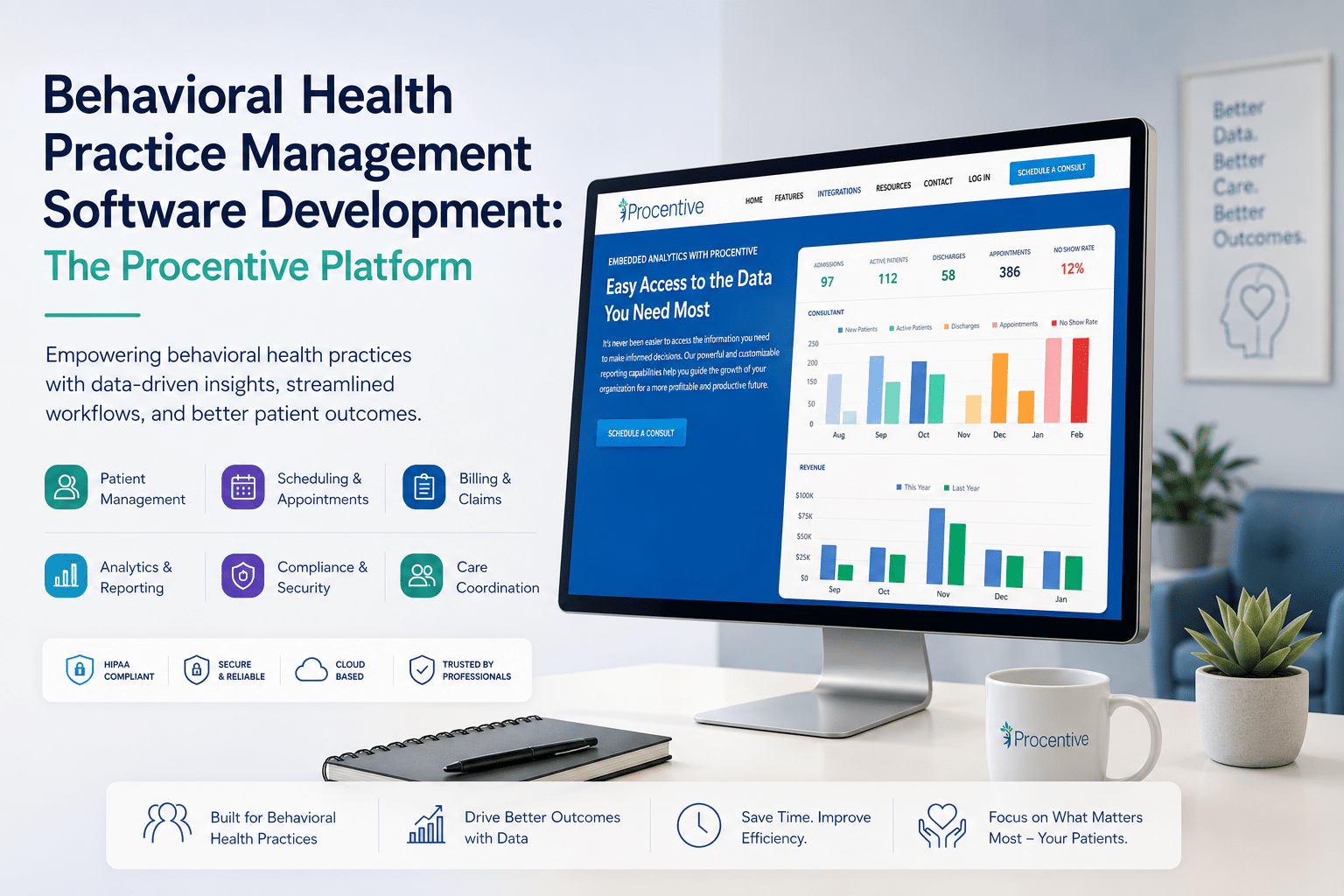
Taction Software built Procentive, a HIPAA-compliant SaaS practice management platform for mental, behavioral, and rehabilitative therapy providers. The platform unifies patient scheduling, a client portal, clinical EHR, a configurable workflow engine, billing and transaction management, front office operations, and embedded self-service analytics in a single system built on Node.js, MongoDB, and Vue.js. Procentive now sits within the Therapy Brands portfolio.
Quick Results
| Outcome | Detail |
| Modules unified in one platform | Seven: authentication, client portal, clinical EHR, workflow engine, billing, front office, analytics |
| Compliance posture | HIPAA-aligned SaaS architecture with role-based access control, encryption, and audit logging |
| Reporting model | Self-service dashboards configurable by practice staff without developer involvement |
| Delivery model | Multi-tenant SaaS, new practices onboard without separate deployments |
| Platform outcome | Acquired into the Therapy Brands portfolio |
Book a 30-minute build assessment
Client Overview
Procentive is a healthcare technology company serving mental, behavioral, and rehabilitative therapy providers across the United States. Its purpose-built practice management, data, and billing solutions support both clinical delivery and financial operations for therapy organizations.
Taction Software was engaged to build and extend the platform’s core modules, with emphasis on HIPAA-compliant SaaS architecture, embedded reporting, and unified workflows spanning front office, clinical, and revenue cycle functions. The platform has since moved under the Therapy Brands portfolio.
The Challenge
Behavioral health is one of the hardest verticals in healthcare software. Documentation requirements are heavier than general practice, confidentiality rules are stricter, and reimbursement depends on clinical notes that most systems keep in a separate place from billing.
Procentive needed to solve four problems simultaneously.
Fragmented systems. Therapy providers typically run scheduling, clinical documentation, prescriptions, and billing in separate tools. Every handoff between them is a failure point where a claim gets denied or a follow-up appointment never gets booked.
Compliance as architecture, not afterthought. A behavioral health platform handles some of the most sensitive protected health information in healthcare. HIPAA safeguards had to be structural rather than a layer added before launch.
Reporting bottlenecks. Practice leadership needed operational and financial visibility. In most systems that means exporting to spreadsheets and making decisions on last month’s data.
Multi-tenant scale. As a commercial SaaS product serving many independent practices, the platform needed tenant isolation without a separate deployment for every customer.
Our Solution
A single platform where the clinical record, the appointment, and the charge are the same object.
When a clinician signs documentation, the billing module already has what it needs. When a patient reschedules in the portal, the front office calendar and the provider’s day both update. No re-entry, no nightly sync, no reconciliation between systems. This is the architectural pattern behind our behavioral health and custom healthcare software development work.
Implementation and Approach
Discovery and workflow mapping. We mapped how therapy practices actually move a patient from intake through documentation to claim, including the exception paths that break generic EHR software.
Compliance architecture first. Role-based access control, encryption in transit and at rest, and audit logging were specified before feature work began, so protected health information handling became a design constraint rather than a retrofit. Our standard for HIPAA-compliant software development applies from the first sprint.
Multi-tenant data model. Tenant isolation designed into the schema so new practices onboard without infrastructure work.
Module-by-module delivery. Authentication and clinical core first, then front office and client portal, then billing, then the workflow engine, then analytics on top of a now-unified data layer.
Analytics deliberately last. Reporting built on a fragmented data model produces reports nobody trusts. Sequencing analytics after consolidation was a decision, not a scheduling accident.
Configurable reporting layer. Rather than ship fixed dashboards and absorb change requests indefinitely, we built a reporting engine practice staff configure themselves.
Technology Stack
Procentive runs on one configuration of our broader healthcare technology stack.
| Layer | Technology | Engineering rationale |
| Frontend | Vue.js | Reactive rendering suits dashboard-heavy reporting views with frequent state changes |
| Backend | Node.js | Handles concurrent API traffic across portal, clinical, and billing modules efficiently |
| Database | MongoDB | Document model accommodates varied clinical note structures and user-defined report definitions without rigid schema migration |
| Delivery | Multi-tenant SaaS | New practices onboard without separate deployments |
If your organization already runs a stack, we build in it. This one was selected for the reporting load and document variability specific to behavioral health.
Key Features
Secure authentication and access control. Login and signup flows with role-based permissions separating clinician, administrative, and patient access paths.
HIPAA-compliant SaaS foundation. Multi-tenant architecture with encryption in transit and at rest, audit logging, and access controls aligned to HIPAA administrative and technical safeguards.
Client portal. Patients book and manage appointments, view prescriptions, and communicate with the practice directly. The same interaction patterns carry into our wider healthcare app development work for therapy providers.
Clinical EHR. Patient reports, clinical notes, and document management, with every record tied to the encounter and to downstream billing.
Workflow engine. Configurable task routing with ownership, due dates, and supervisor visibility on anything overdue.
Billing and financial module. Claim generation, payment posting, and transaction reconciliation connected directly to the clinical record.
Front office solution. Appointment and provider management including calendar views, provider availability, and check-in handling.
Embedded analytics. Dashboards covering appointment volume, cancellations, follow-ups, and financial performance, configurable by staff without filing a developer ticket.
Results and Business Impact
Operational consolidation. Scheduling, documentation, prescriptions, task routing, and billing operate on one data layer instead of four systems bridged by manual work.
Revenue cycle integrity. Because clinical documentation and charges share a record, the denial pattern caused by documentation gaps is addressed structurally rather than through post-hoc auditing.
Reporting independence. Practice leadership configures its own reports. That removes the export-to-spreadsheet habit and removes recurring reporting requests from the engineering backlog.
Scalable commercial model. Multi-tenant delivery lets the platform add practices without per-customer infrastructure cost.
Market validation. The platform was acquired into the Therapy Brands portfolio, which is the strongest available external signal on the durability of what was built.
See whether your workflows fit this architecture
Why Our Approach Worked
Healthcare specialization, not general development. Taction Software has built healthcare technology since 2013, and our CEO brings 20 or more years of personal experience in the space. Behavioral health confidentiality requirements and therapy documentation patterns were known inputs, not discoveries made mid-project.
Compliance treated as architecture. Specifying HIPAA safeguards before feature work is the difference between a platform that passes review and one refactored under deadline pressure.
Analytics built on a unified data layer. Reporting is only trustworthy when the underlying records already agree with each other.
Self-service reporting over custom report requests. Building configurability once eliminated an indefinite stream of change requests, protecting both the client’s budget and the product roadmap.
Comparable work in the portfolio. Other healthcare platform builds include Voyant Health, Revive Ease, PainKare, and CHIPSS. Teams for engagements like this are staffed the same way we staff a dedicated healthcare development team.
Investment Ranges
| Scope | Investment |
| MVP: scheduling, clinical notes, patient portal | $40,000 to $80,000 |
| Full platform: adds billing, workflow engine, analytics | $80,000 to $200,000 |
| Enterprise: multi-state, multi-entity, custom integrations | $200,000 and up |
Where a project lands depends on integration count, state and payer requirements, and whether existing patient data needs migrating.
Related Services
- Healthcare software development services
- Behavioral health and custom healthcare software development
- HIPAA-compliant software development
- Healthcare app development
- Healthcare technology stack and solutions
- Dedicated healthcare development team
Frequently Asked Questions
What is behavioral health practice management software?
Software that unifies scheduling, clinical documentation, prescriptions, task management, and billing for mental, behavioral, and rehabilitative therapy providers. Unlike general EHR software, it accommodates the heavier documentation and stricter confidentiality requirements specific to behavioral health.
How long does a behavioral health platform build take?
An MVP covering scheduling, clinical notes, and a patient portal typically runs three to five months. A full platform with billing, workflow, and analytics runs longer depending on integration scope.
Will the platform be HIPAA compliant?
We build to HIPAA administrative and technical safeguards: encryption in transit and at rest, role-based access control, and audit logging. Full compliance also depends on your internal policies and business associate agreements, which we help scope.
Can you integrate with our existing billing system or clearinghouse?
Yes. Integration count is one of the main cost drivers, so bring your list to the scoping call.
Can we migrate patient data from our current EHR?
Yes. Migration is scoped separately based on data volume, source system, and record quality.
Do you build for individual practices or for software companies?
Both. Procentive was a software company building a commercial product. We also build in-house platforms for provider groups.
Why Node.js, MongoDB, and Vue.js for this platform?
The combination suits reporting-heavy interfaces and variable clinical document structures. If your organization has an existing stack, we build in that instead.
Who owns the code?
You do.
Ready to Build Something Similar
If your practice or product runs scheduling, documentation, and billing in separate systems, the fix is architectural rather than another integration. We will look at your workflows and tell you what a unified platform would take.