
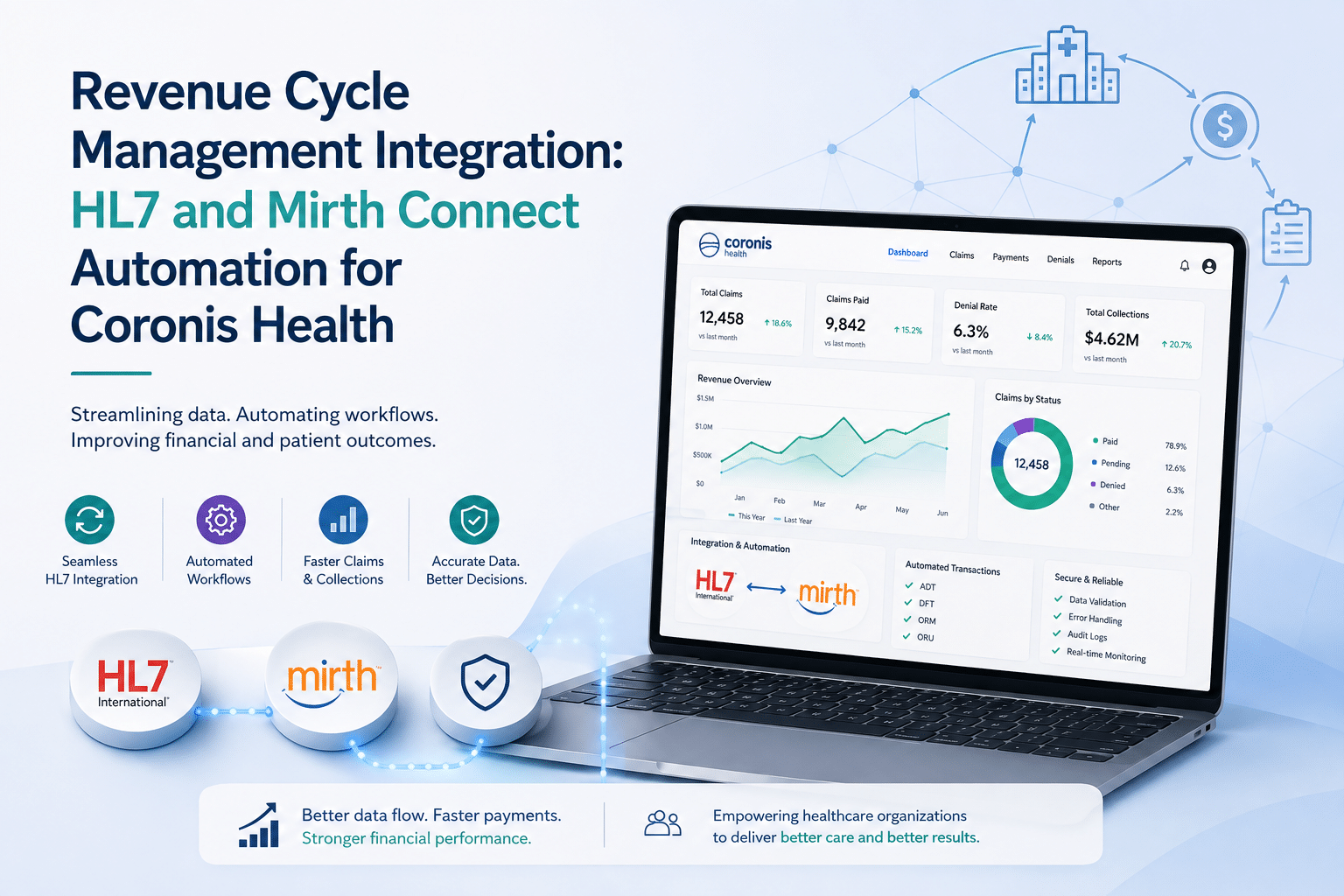
Taction Software built a web-based data and process management platform for Coronis Health, a global revenue cycle management company serving healthcare practices and facilities. The system automates data exchange across multiple billing platforms using HL7 secured channels customized in Mirth Connect, with server-side HL7 field validation, per-transaction crosswalks, audit management, and service group management. It runs on WordPress, AngularJS, and Mirth Connect.
Quick Results
| Outcome | Detail |
| Data exchange | Automated across multiple billing platforms, replacing manual transfer |
| Integration engine | HL7 secured channels customized in Mirth Connect |
| Data quality control | Server-side HL7 validation applied to patient data fields before processing |
| Transaction mapping | Crosswalks implemented per transaction type across connected systems |
| Governance | Audit management and service group management built into the platform |
| Client scope | Global RCM operation serving practices and facilities, including CRT Medical Systems in southeastern Michigan |
Book a 30-minute integration assessment
Client Overview
Coronis Health is a global revenue cycle management company offering specialized solutions to healthcare practices and facilities. It combines industry-leading technology with high-touch relationship building, allowing healthcare practitioners to focus on patient care, maintain financial independence, and cultivate financial success.
Coronis Health operates through a group of specialist billing companies, including CRT Medical Systems, a southeastern Michigan medical billing firm with more than 30 years in clinical practice billing. Taction Software was engaged to build the web application and integration layer that moves patient and transaction data between Coronis Health’s operations and the billing platforms its client practices run on.
The Challenge
Revenue cycle management is an integration problem before it is a billing problem. An RCM company does not control the systems its clients use. It inherits them.
Coronis Health faced four constraints at once.
Many billing platforms, one operation. Client practices run different billing and practice management systems. Every one of them formats patient and transaction data differently. Without a common integration layer, each new client relationship means bespoke data handling and a new source of manual work.
HL7 variability. HL7 is intentionally flexible, which means two systems sending the same message type will differ in field mappings, segment usage, and optional fields. Data arriving unvalidated propagates errors straight into claims.
Manual data exchange. Moving data between systems by hand does not scale with client growth, and every manual touch is a place where a transaction gets mishandled.
Auditability. RCM operations answer to payers, to client practices, and to regulators. Every transaction needs a traceable record of what arrived, what it was transformed into, and where it went.
Our Solution
A single web application sitting between Coronis Health’s operations and every billing platform it connects to, with Mirth Connect handling the message routing and transformation underneath.
Rather than build a point-to-point connection for every client system, we built one integration layer with configurable channels and crosswalks. New billing platforms are added as configuration rather than as new code. This is the same architecture pattern behind our healthcare integration and interoperability services.
Implementation and Approach
Interface and data flow mapping. We documented every source system, message type, and field-level difference across the billing platforms in scope before writing channel logic.
Mirth Connect channel development. HL7 secured channels were built and customized in Mirth Connect to receive, filter, transform, and route messages between systems. Channel design carried the transformation logic so system-specific quirks stayed out of the application layer. Our broader Mirth Connect integration practice was applied directly here.
Server-side HL7 validation. Validation rules were implemented on the HL7 server for patient data fields, so malformed or incomplete messages are caught at the boundary rather than surfacing later as a denied claim.
Per-transaction crosswalks. Each transaction type received its own crosswalk, mapping codes and field values between source and destination systems. This is the layer that lets one platform speak to many billing systems without loss of meaning.
Audit management. Transaction-level logging built in from the start, giving traceability across the full data path for compliance review and client reporting.
Service group management. Administrative structure for organizing client practices and service lines, so operations teams manage relationships and permissions inside the platform.
Automation of the exchange process. With channels, validation, and crosswalks in place, routine data movement between systems runs without manual handling.
Technology Stack
| Layer | Technology | Engineering rationale |
| Frontend | AngularJS | Structured two-way data binding suits form-heavy administrative and validation interfaces |
| Web platform | WordPress | Content and public-facing layer maintainable by the client’s own team without developer involvement |
| Integration engine | Mirth Connect | Industry-standard healthcare interface engine for HL7 message routing, filtering, and transformation |
Mirth Connect was not a preference, it was the correct tool. It is the engine most widely deployed for HL7 routing in US healthcare, which means the integration layer uses patterns other vendors and client IT teams already recognize. Full detail on our approach sits in our HL7 and Mirth Connect integration practice.
Key Features
Web application for data and process management. A single operational interface for managing data flows and transaction processes across connected systems.
Automation of the data exchange process. Routine transfer between Coronis Health and client billing platforms runs automatically rather than by hand.
Integration with multiple billing platforms. One integration layer supporting many destination systems instead of point-to-point connections per client.
HL7 secured channel customization with Mirth Connect. Purpose-built channels handling routing, filtering, and transformation for each connected system.
HL7 server validations for patient data fields. Field-level validation applied at the boundary, catching bad data before it reaches billing.
Crosswalk implementation for each transaction. Per-transaction code and field mapping between source and destination systems.
Audit management. Traceable transaction records across the full data path.
Service group management. Administrative organization of client practices and service lines within the platform.
Results and Business Impact
Manual data handling replaced by automated exchange. The routine work of moving patient and transaction data between systems no longer consumes operations staff time.
Data errors caught at the boundary. Server-side HL7 validation stops malformed patient data before it becomes a denied claim, which is the cheapest possible point to catch it.
New billing platforms onboard as configuration. Crosswalks and channels mean adding a client system is a configuration exercise rather than a development project, which directly affects how fast Coronis Health can take on new practices.
Audit trail available on demand. Transaction-level logging supports payer inquiries, client practice reporting, and compliance review without reconstruction work.
Operational structure that matches the business. Service group management reflects how an RCM company actually organizes client relationships, rather than forcing operations into a generic admin model.
See what your integration layer would take
Why Our Approach Worked
HL7 experience, not HL7 learning. Taction Software has built healthcare integrations since 2013, and our CEO brings 20 or more years of personal experience in the space. HL7 field variability and crosswalk design were known problems, not discoveries made mid-project.
One integration layer instead of many connections. Point-to-point integration looks faster on the first client and becomes unmanageable by the fifth. Building the abstraction first was the decision that made multi-platform support sustainable.
Validation placed at the boundary. Catching bad data on arrival costs a validation rule. Catching it after a claim is denied costs staff hours and reimbursement delay.
Audit built in, not added later. Retrofitting traceability into a live integration is significantly harder than designing for it, and in a regulated revenue cycle context it is not optional.
Comparable work in the portfolio. Other healthcare platform and integration builds include Voyant Health, Revive Ease, PainKare, and CHIPSS. Engagements like this are staffed the same way we staff a dedicated healthcare development team.
Investment Ranges
| Scope | Investment |
| MVP: single integration layer, core HL7 channels, validation | $40,000 to $80,000 |
| Full platform: adds multi-platform crosswalks, audit management, admin console | $80,000 to $200,000 |
| Enterprise: multi-entity, high transaction volume, extensive payer and system integrations | $200,000 and up |
Position depends on the number of source systems, message types in scope, and how much variance exists between connected platforms.
Related Services
- Healthcare integrations and interoperability services
- Mirth Connect integration
- HL7 and Mirth Connect integration
- Medical billing software development
- Healthcare software development services
- Dedicated healthcare development team
Frequently Asked Questions
What is HL7 integration in revenue cycle management?
HL7 integration moves patient demographic, encounter, and transaction data between clinical systems and billing platforms using the HL7 messaging standard. In revenue cycle management it is what allows an RCM company to receive data from many different client systems and process claims from it without manual re-entry.
Why use Mirth Connect instead of building custom integrations?
Mirth Connect is a healthcare interface engine that handles message receipt, filtering, transformation, and routing as configurable channels. It removes the need to write and maintain bespoke code for each connection, and it is widely deployed in US healthcare, so client IT teams generally already understand it.
What is a crosswalk in healthcare data integration?
A crosswalk maps codes and field values between two systems that represent the same information differently. Without one, data transfers technically succeed while carrying the wrong meaning, which is how integrations produce clean-looking bad claims.
How long does a healthcare integration platform build take?
An initial integration layer with core HL7 channels and validation typically runs three to five months. Timeline scales with the number of source systems and message types in scope.
Can you integrate with our existing billing platform or clearinghouse?
Yes. System count and the degree of variance between them are the main cost drivers, so bring the full list to the scoping call.
Is HL7 integration HIPAA compliant?
It has to be. Integration channels carry protected health information, so secured transport, access control, and audit logging are structural requirements rather than optional additions.
Why WordPress and AngularJS for this build?
WordPress gave the client an editable public-facing layer without developer dependency. AngularJS suited the form-heavy administrative and validation interfaces. If your organization runs a different stack, we build in it.
Who owns the code?
You do.
Ready to Solve a Similar Integration Problem
If your revenue cycle operation is handling data from client systems manually, or every new client means another custom connection, the constraint is architectural. We will map your current data flows and tell you what a single integration layer would take.