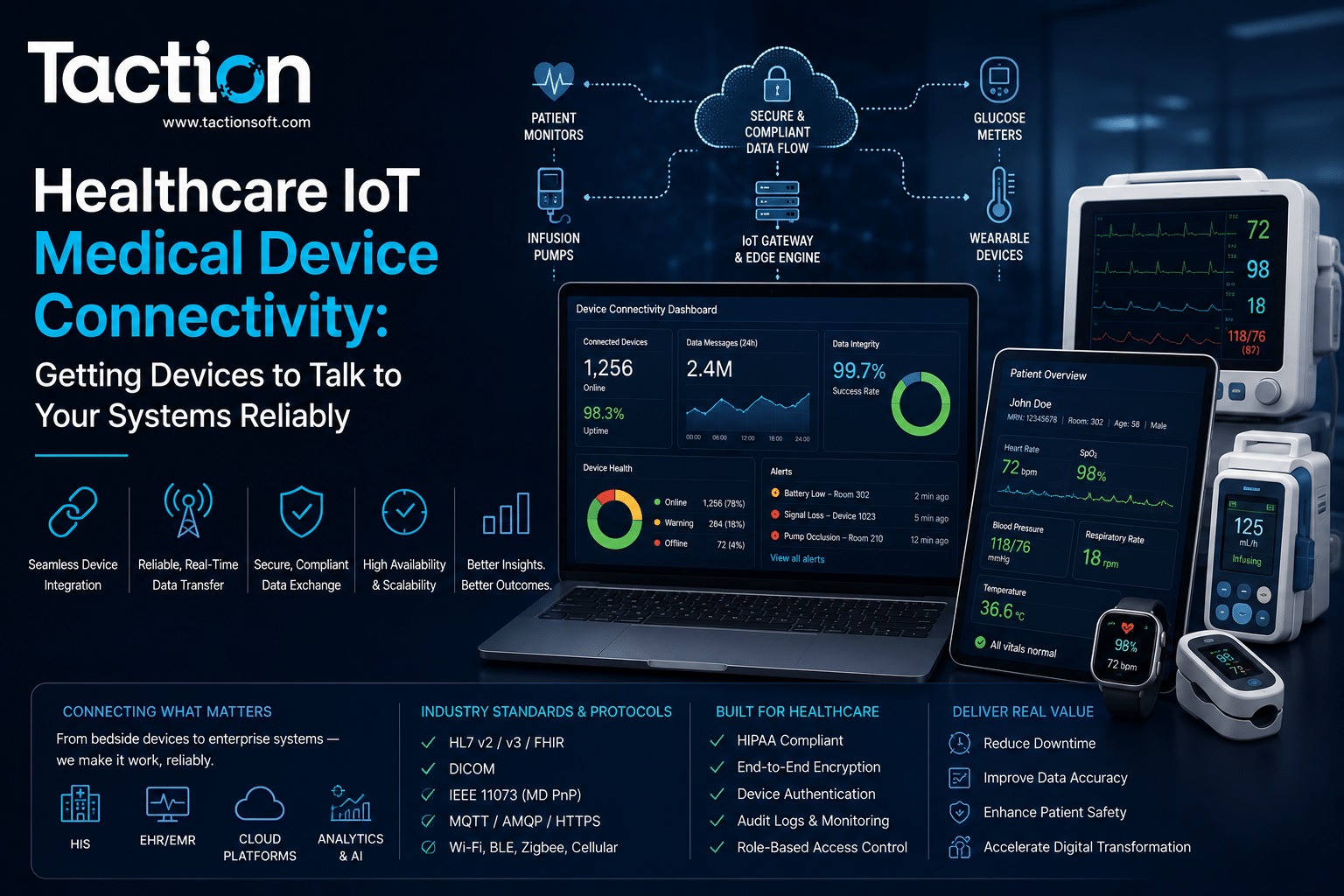
Healthcare IoT medical device connectivity refers to the technical layer that lets bedside monitors, infusion pumps, wearable sensors, and other connected medical devices transmit data reliably into EHRs, monitoring platforms, and clinical alerting systems, and it is consistently the hardest part of any connected health initiative to get right. Health systems can buy the best monitoring devices on the market and still end up with a fragmented, unreliable data pipeline if the underlying connectivity architecture, protocol translation, network segmentation, device management, was not designed deliberately from the start. This page covers the core technical challenges in medical device connectivity, protocol and standards considerations, network architecture requirements, and how to plan a connectivity project that scales beyond a single device type.
Core Technical Challenges in Device Connectivity
Medical device connectivity looks simple on a vendor’s product sheet and gets considerably more complicated once multiple device types and manufacturers enter the picture.
Protocol Fragmentation Across Device Manufacturers
Different medical device manufacturers use different communication protocols, some proprietary, some based on older standards, and a connectivity architecture needs a translation or gateway layer capable of normalizing this fragmented protocol landscape into a consistent data format before it reaches downstream systems.
Data Volume and Streaming Requirements
Continuous monitoring devices, bedside vitals monitors, wearable sensors, generate a near-constant stream of data, which is a fundamentally different technical problem than the periodic, discrete data exchange most EHR integrations were originally designed to handle. Connectivity architecture needs to account for this volume without overwhelming downstream systems or losing clinically significant data points in the process.
Device Identity and Association
A recurring practical problem in hospital settings is correctly associating a specific device reading with the correct patient, particularly when devices move between rooms or are shared across a unit. Getting this association wrong creates both clinical safety risk and significant downstream data quality problems that are difficult to correct after the fact.
Standards and Protocols for Medical Device Data
A handful of standards form the backbone of most modern medical device connectivity architectures, though implementation still varies significantly by device category.
HL7 and FHIR for Structured Data Exchange
Once device data has been normalized by a gateway layer, HL7 and FHIR standards typically govern how that structured data moves into the EHR and other clinical systems, providing a consistent format that downstream applications can reliably parse regardless of the original device manufacturer.
IEEE 11073 for Device-Level Communication
IEEE 11073 defines standards specifically for point-of-care medical device communication, and devices that support this standard natively require less custom integration work than proprietary alternatives, which is worth factoring into procurement decisions alongside clinical feature comparisons.
Network Architecture for Medical Device Connectivity
The network layer underneath device connectivity carries real security and reliability implications that go beyond simple data transmission.
Network Segmentation for Medical Devices
Medical devices should sit on a properly segmented network separate from general hospital IT traffic, both to reduce the attack surface these often less frequently patched devices represent and to prevent unrelated network congestion from affecting time-sensitive clinical data transmission. This segmentation approach connects directly to the broader security architecture covered in our page on healthcare API security services, where controlling what talks to what across the network is a foundational security principle, not an optional add-on.
Redundancy and Failover for Critical Monitoring Data
For devices monitoring patients in critical care settings, the connectivity architecture needs built-in redundancy so that a network hiccup does not create a gap in monitored data reaching the clinical team, since a missed alert due to a connectivity failure carries direct patient safety consequences.
Connectivity for Remote and Ambulatory Devices
Not all medical device connectivity happens inside a hospital network, and remote and home-based devices introduce a distinct set of requirements.
Cellular and Home Network Connectivity for RPM Devices
Devices used in remote patient monitoring programs need to transmit reliably over cellular networks or a patient’s home internet connection, which is considerably less controlled and predictable than a hospital’s internal network, requiring more robust error handling and retry logic in the connectivity layer. This is a core requirement covered in depth in our work on remote patient monitoring app development, where connectivity reliability directly determines whether a monitoring program actually catches clinically significant events.
Battery and Bandwidth Constraints for Wearable Sensors
Wearable and implantable sensors often operate under strict battery life constraints, which shapes how frequently they can transmit data and what compression or batching strategies the connectivity architecture needs to support without draining the device faster than clinically acceptable.
Planning a Connectivity Architecture That Scales
Organizations building or expanding medical device connectivity should design for the device diversity they will have in two years, not just the devices in use today.
Starting With a Gateway or Middleware Layer
Rather than building point-to-point integrations for each device type, a centralized gateway or middleware layer that normalizes device data before it reaches the EHR and monitoring systems scales far more sustainably as new device types are introduced, since each new device only needs to integrate with the gateway, not with every downstream system independently.
Governance for Device Onboarding
As new devices are approved for clinical use, having a defined technical onboarding process, protocol validation, network segmentation assignment, data mapping to the gateway, prevents connectivity architecture from becoming an ad hoc patchwork that grows harder to maintain with each new device added.
Key Takeaways
Healthcare IoT medical device connectivity depends on solving protocol fragmentation, data volume handling, and device-patient association at the technical layer, supported by proper network segmentation and standards like HL7, FHIR, and IEEE 11073. A gateway or middleware approach that normalizes device data before it reaches downstream systems scales far better than point-to-point integrations as device diversity grows. If your organization is planning a device connectivity project, connect with our team to review your current device landscape and integration goals.
Frequently Asked Questions
Why is medical device connectivity harder than typical EHR integration?
Continuous monitoring devices generate constant data streams rather than discrete transactions, and different manufacturers use different, often proprietary protocols, requiring a translation layer that standard EHR integration approaches were not originally designed to handle.
What standards govern medical device connectivity?
HL7 and FHIR govern structured data exchange into clinical systems, while IEEE 11073 defines standards specifically for point-of-care device communication at the device level.
How should medical devices be segmented on a hospital network?
Medical devices should sit on a network segment separate from general hospital IT traffic, reducing the attack surface and preventing unrelated network activity from affecting time-sensitive clinical data transmission.
How does connectivity differ for remote patient monitoring devices compared to in-hospital devices?
Remote devices rely on cellular or home internet connections that are less predictable than hospital networks, requiring more robust error handling and retry logic to ensure clinically significant data is not lost in transmission.
What is the best approach for connecting many different device types to one system?
A centralized gateway or middleware layer that normalizes data from multiple device types before passing it to downstream systems scales more sustainably than building separate point-to-point integrations for each device.