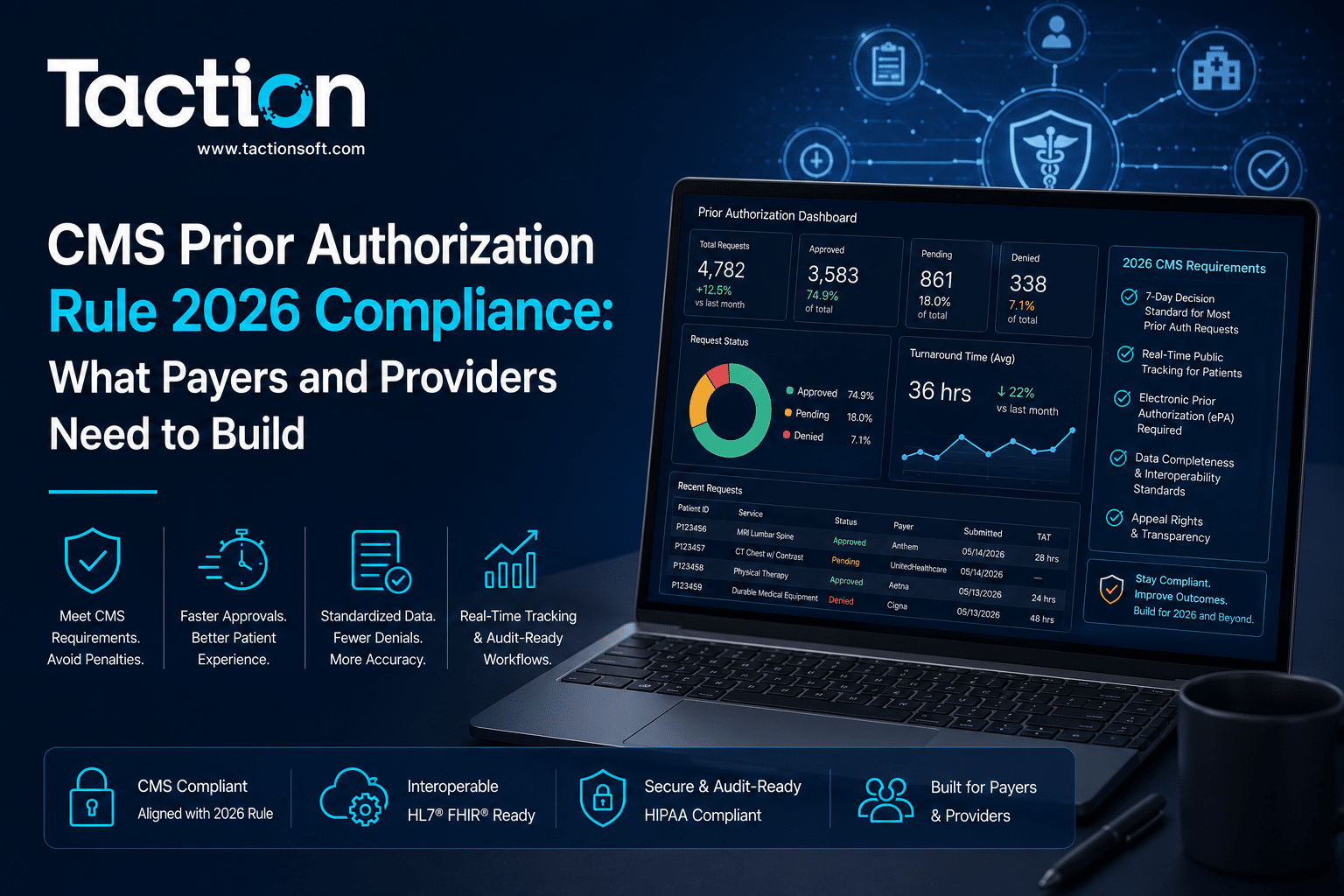
CMS Prior Authorization Rule 2026 compliance requires payers and providers to move away from fax-and-portal prior authorization processes toward standardized, API-driven exchange with defined response timelines, and organizations that treat this as a paperwork update rather than a systems project are going to miss the deadline. The rule sets specific requirements around turnaround times, denial reason transparency, and electronic prior authorization data exchange using FHIR-based APIs, which means compliance is fundamentally a software and interoperability problem, not just a policy update. This page breaks down what the rule actually requires, the technical architecture needed to comply, how it differs from prior authorization automation efforts already underway at many organizations, and how to plan implementation before enforcement begins.
What the Rule Requires
The rule centers on standardizing how prior authorization requests, responses, and denials move between payers and providers, replacing today’s fragmented mix of fax, portal, and phone processes.
Turnaround Time Requirements
The rule establishes maximum response windows for both standard and expedited prior authorization requests, with payers required to meet these timelines or face compliance action. This shifts prior authorization from an open-ended waiting period into a measurable, enforceable service level, which changes how payer operations teams need to staff and monitor their review queues.
Denial Reason Transparency
Payers must provide a specific, structured reason for any prior authorization denial, rather than a generic rejection code. This requirement alone has significant downstream implications for how utilization management systems are built, since denial reasoning needs to be captured in structured data at the point of decision, not reconstructed after the fact for reporting purposes.
Electronic Data Exchange via FHIR APIs
The rule mandates that prior authorization requests and decisions be exchanged using standardized FHIR-based APIs rather than proprietary payer portals or fax transmission. This is the same interoperability foundation covered in our detailed breakdown of the CMS interoperability rule compliance requirements, though the prior authorization rule adds specific workflow and timing requirements on top of the base interoperability mandate.
Technical Architecture Needed for Compliance
Meeting these requirements means building or integrating several distinct technical components, not just updating a policy document.
Prior Authorization API Endpoints
Payers need to expose FHIR-based prior authorization request and response endpoints that can accept structured clinical data from provider systems and return decisions in the required format and timeframe. Providers, on their side, need EHR or practice management integrations capable of submitting these requests programmatically rather than relying on staff to manually enter data into a payer portal.
Structured Clinical Data Capture
For prior authorization decisions to be made and communicated within the required turnaround windows, the clinical data supporting the request needs to arrive in structured form, diagnosis codes, procedure codes, supporting documentation, rather than as an attached PDF that a reviewer has to read manually. This is where many organizations underestimate the lift involved, since structured data capture upstream in the clinical workflow is a prerequisite for meeting downstream automation timelines.
Audit Logging and Decision Tracking
Given the denial transparency requirement, the underlying utilization management system needs to log the specific reasoning behind each decision in a structured, queryable format that can support both the immediate provider-facing denial reason and any subsequent audit or reporting obligation.
How This Differs From General Prior Auth Automation
Many organizations already have some form of prior authorization automation in place, and it is worth understanding how the 2026 rule’s requirements relate to, and go beyond, those existing efforts.
Automation for Efficiency Versus Automation for Compliance
Existing automation initiatives, like the workflow improvements covered in our page on automating prior authorization, have generally focused on reducing manual review time and speeding internal turnaround. The 2026 rule adds a compliance layer on top of that, specific external API standards, enforced timelines, and structured denial transparency that exist independent of whether an organization has already optimized its internal review process.
Utilization Management System Readiness
Organizations running utilization management on legacy systems built before FHIR became a standard requirement often need a modernization project, not just a configuration change, to meet the rule’s API and data structure requirements. This connects directly to broader modernization work covered in our page on utilization management software development, which addresses the underlying system architecture question this rule ultimately depends on.
Planning Your Compliance Timeline
Given the technical dependencies involved, structured data capture upstream, FHIR API development, audit logging, organizations should not wait until close to the enforcement date to begin scoping this work.
Gap Assessment First
Start with an honest assessment of how much of your current prior authorization data already flows in structured form versus how much still depends on manual entry, attached documents, or phone-based communication. This gap assessment determines whether the compliance project is primarily an integration effort or a more substantial data capture redesign.
Phased Rollout by Service Line
Rather than attempting a single organization-wide cutover, phasing the rollout by service line or payer relationship, starting with the highest-volume prior authorization categories, allows the technical team to validate the API integration and turnaround time performance before scaling to the full authorization volume.
Key Takeaways
CMS Prior Authorization Rule 2026 compliance requires building standardized FHIR-based API exchange, meeting enforced turnaround timelines, and capturing structured denial reasoning, which together represent a systems modernization project rather than a simple policy update. Organizations already running mature prior authorization automation still need to assess whether their underlying data structure and API layer meet the rule’s specific requirements. If your organization needs help scoping this compliance work, contact our healthcare compliance team to review your current utilization management architecture.
Frequently Asked Questions
Who does the CMS Prior Authorization Rule 2026 apply to?
The rule applies to specific categories of payers, including Medicare Advantage plans and other CMS-regulated programs, along with the providers submitting prior authorization requests to them. Specific applicability depends on plan type and program participation.
What happens if a payer misses the required turnaround time?
Missing the established turnaround windows exposes payers to compliance action under the rule, which is why building automated, structured decision workflows matters, manual review processes struggle to consistently meet enforced timelines at scale.
Does this rule replace existing prior authorization portals?
Not necessarily immediately, but the rule requires FHIR-based API exchange as a standardized alternative, which over time is expected to reduce reliance on proprietary payer portals as the primary submission method.
How is this different from the CMS interoperability rule?
The interoperability rule establishes the broader FHIR-based data exchange foundation across patient access and provider directory data. The prior authorization rule builds specific workflow, timing, and transparency requirements on top of that same technical foundation, focused specifically on authorization requests and decisions.
How long does it typically take to build compliant prior authorization infrastructure?
Timelines vary significantly based on how much of an organization’s current data already flows in structured form. Organizations starting from a strong existing FHIR integration may need only a few months, while those relying heavily on manual or document-based workflows should plan for a longer modernization project.