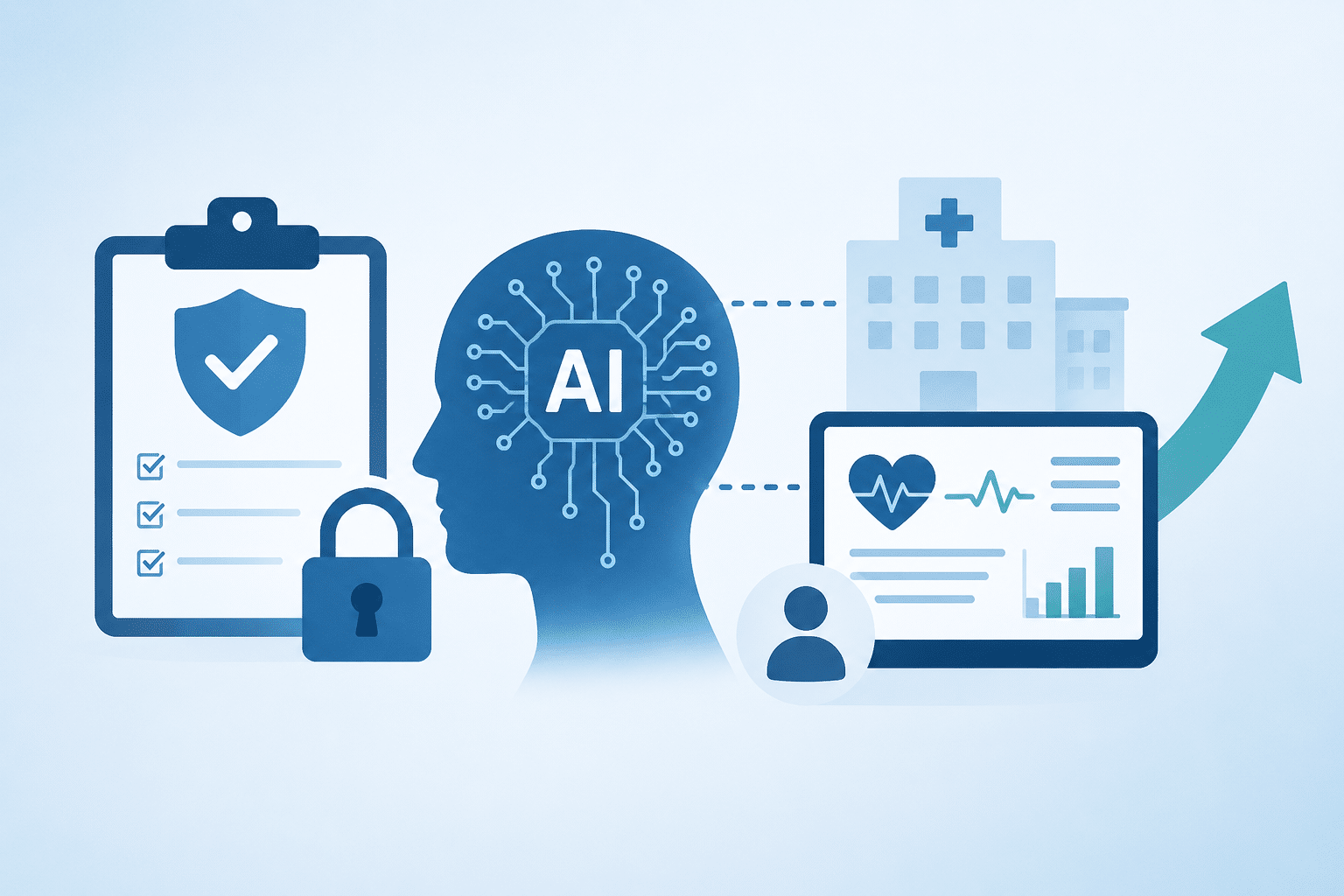
Artificial intelligence in healthcare has moved past the hype cycle. Hospitals no longer ask “should we use AI?” — they ask “which AI actually reduces readmissions, cuts documentation time, or catches a deteriorating patient before it’s too late?” The gap between flashy AI demos and dependable clinical deployment is where most projects stall. Success in 2025 rests on three pillars: Compliance, Integration, and Outcomes. This is a practical roadmap for CIOs, product managers, and clinical leads who need proof, not promises, before greenlighting an AI investment. The Operational AI Stack: Features That Fix the Front and Back Office Before AI touches a diagnosis, it should fix the operational bottlenecks draining staff time and revenue. These are the highest-ROI, lowest-risk entry points for most health systems. Predictive Scheduling & Capacity Management Machine learning models trained on historical admission patterns, seasonality, and local event data can forecast ER surges and optimize OR block scheduling. Predictive no-show algorithms that factor in weather, transportation access, and patient history have been shown to reduce no-shows by up to 30% when paired with automated reminder workflows. Intelligent Patient Portals NLP-powered chatbots now handle appointment booking, prescription refill requests, and pre-visit intake questionnaires — reducing front-desk call volume and improving data quality before the patient even arrives. Revenue Cycle Automation AI applied to prior authorization, claims scrubbing, and denial management can flag coding errors before submission, shortening the revenue cycle and reducing costly rework for billing teams. Ambient Clinical Intelligence (AI Scribes) Ambient documentation tools listen to patient-clinician conversations and generate structured notes automatically. This directly targets physician burnout — one of the most measurable and immediate wins available to health systems today. The Clinical AI Stack: Features That Improve Diagnosis and Treatment Once operational foundations are stable, clinical AI delivers the next layer of value — but with a much higher bar for validation. Medical Imaging Triage AI models trained on large annotated imaging datasets can flag time-critical findings — such as intracranial hemorrhage or pulmonary embolism — and push them to the top of a radiologist’s queue, shrinking time-to-diagnosis for the sickest patients. Clinical Decision Support (CDS) Apps CDS tools generate real-time alerts for drug-drug interactions, sepsis risk scores, and early signs of patient deterioration. When integrated correctly, they act as a second set of eyes rather than another alert clinicians learn to ignore. Genomic & Precision Medicine AI-assisted variant interpretation accelerates the translation of genomic sequencing into actionable treatment matching, particularly in oncology, where time-to-therapy decisions matter. Remote Patient Monitoring (RPM) Wearable and home-device data streams feed models that predict exacerbations in chronic conditions like COPD and congestive heart failure — enabling intervention days before a hospital visit becomes necessary. The Compliance Prerequisite: Why HIPAA Is Your First Feature No feature list matters if the underlying system can’t be trusted with protected health information (PHI). Compliance isn’t a checkbox added at the end — it’s the architecture the entire application is built on. HIPAA Compliance Is Non-Negotiable Any AI vendor touching PHI needs a signed Business Associate Agreement (BAA), enforced encryption at rest and in transit, and granular, role-based access controls. This is table stakes, not a differentiator. The Cloud Security Trap Generic public AI tools frequently pose hidden risks: unclear data residency, ambiguous retention policies, and — critically — the possibility that PHI submitted to a consumer-grade model gets used in future training runs. Healthcare organizations should demand explicit contractual guarantees against this. Model Explainability (XAI) A “black box” recommendation is a liability in a clinical setting. Techniques like SHAP and LIME allow clinicians and auditors to see why a model flagged a patient as high-risk, which is essential for both trust and legal defensibility. Audit Trails Every AI-driven decision — from a triage recommendation to a denied claim — must be logged with timestamp, model version, and input data reference, ready for regulatory review at any time. How to Build an AI-Powered Clinical Decision Support App (Step-by-Step) Building a CDS application is less about picking a fancy model and more about disciplined scoping and validation. Here’s the realistic sequence. Step 1 — Define the Clinical Problem Narrow scope wins. “Improve patient outcomes” is not a build spec; “predict sepsis onset in ICU patients within a 4-hour window” is. A tightly defined problem statement determines every downstream decision, from data requirements to success metrics. Step 2 — Data Curation & Labeling This is the hardest and most underestimated step. Clean, de-identified EMR data, properly labeled by clinical experts, is the true bottleneck of most healthcare AI projects — not the algorithm itself. Poor data quality here guarantees poor model performance later, regardless of architecture. Step 3 — Model Selection & Training Start simple. Logistic regression and gradient-boosted trees (like XGBoost) are often more interpretable and just as accurate as deep learning for many structured-data problems. Benchmark performance using standard clinical ML metrics such as AUROC and F1 score, and always compare against the existing clinical standard of care — not just against a theoretical baseline. Step 4 — Integration with EHR (HL7/FHIR) A model that isn’t embedded in the clinician’s existing workflow will be ignored. Integration via HL7 FHIR and SMART on FHIR standards allows the CDS tool to plug directly into Epic, Cerner, or other major EHRs, surfacing alerts inside the chart the clinician is already reviewing. Step 5 — Validation & Deployment Prospective validation in a sandboxed “shadow mode” — where the model runs silently alongside clinical decision-making without influencing it — is essential before any live rollout. This step catches performance drift and false-positive fatigue before they affect real patients. Companies like Taction software, which build HIPAA-compliant healthcare software and manage EHR interoperability projects for hospitals and digital health startups, typically treat this validation phase as non-negotiable before go-live, precisely because skipping it is where most CDS pilots quietly fail. How to Choose the Best AI Healthcare Software Development Company in the US With hundreds of vendors claiming “AI-powered” capabilities, evaluation criteria matter more than marketing claims. Criteria 1
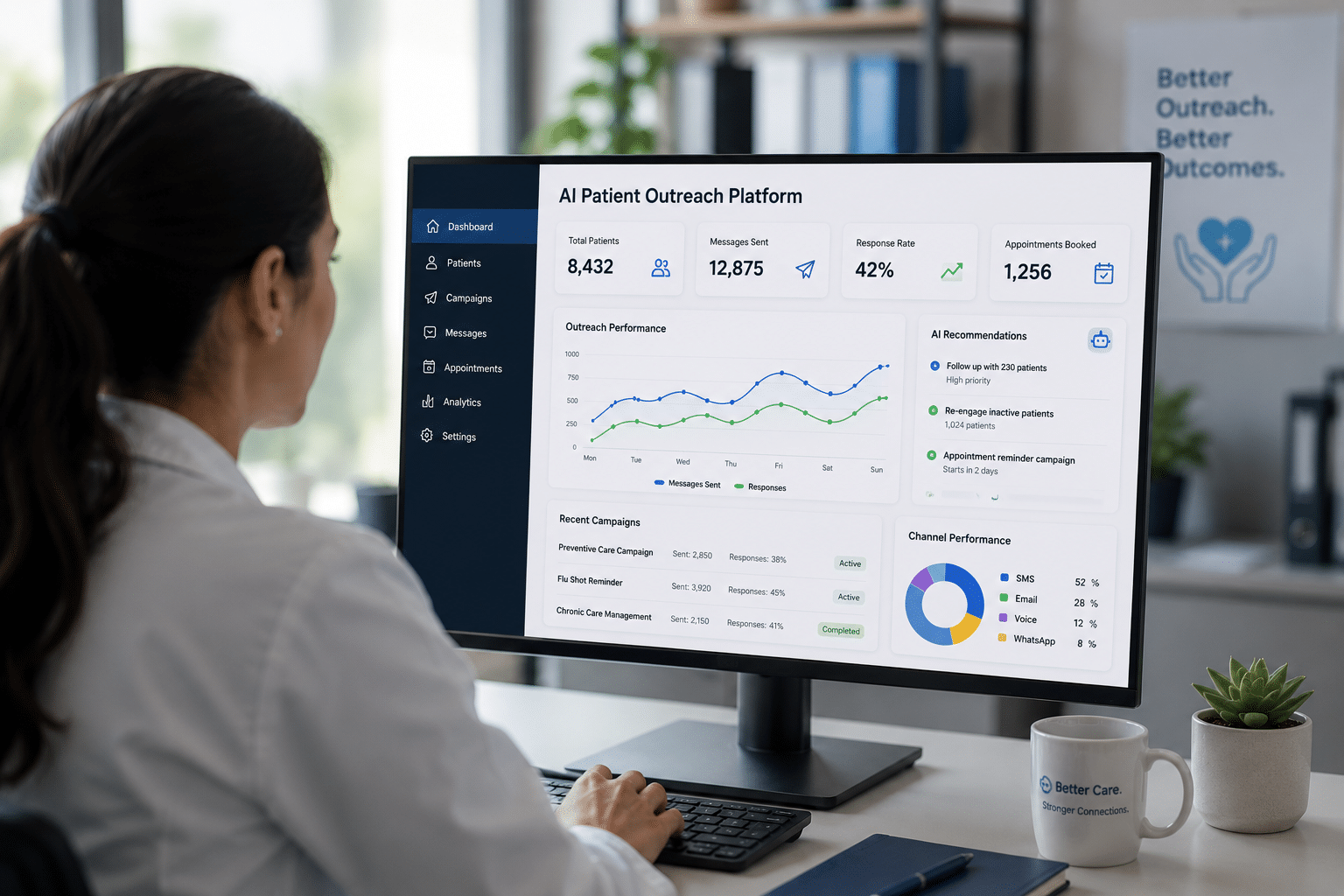
An AI patient outreach platform helps you reach patients proactively and at scale — sending the right message to the right person at the right time, through the channels they actually use. It watches for the moments that call for outreach (an upcoming appointment, an overdue screening, a recent discharge, an open care gap), works out who needs to hear from you and about what, personalizes the message, and can even handle simple back-and-forth replies — while handing anything clinical or urgent to your staff. The goal is plain: fewer missed appointments and missed care, less manual phone tag for your team, and patients who feel looked after. You stay in control of what gets sent, to whom, and when. The patients who need a nudge are the ones you can’t reach by hand A lot of good care depends on a patient doing something outside the visit — coming in for the annual screening, picking up where they left off after a discharge, rebooking the appointment they cancelled, following through on a referral. The trouble is that reaching everyone who needs that nudge, one phone call at a time, simply isn’t realistic. Your staff’s time is finite, the list is long, and so the outreach that actually happens ends up partial and reactive: the squeaky wheels get called, and a lot of other patients quietly slip through. You can see the result in the numbers most practices and health systems watch — no-shows, missed preventive care, gaps that never get closed, patients who drift out of the system and only reappear when something has gone wrong. None of that is for lack of caring; it’s a reach problem. There are only so many hours in the day for phone calls. The answer isn’t to make more phone calls. It’s to let software handle the routine, high-volume outreach — intelligently, personally, and at scale — so your team’s time goes to the conversations that genuinely need a human. That’s what an AI patient outreach platform is for. What an AI patient outreach platform does Here’s what a custom build typically handles, in plain terms. It knows who to reach, and why. Instead of someone building call lists by hand, the platform watches your systems for the triggers that matter — upcoming appointments, overdue or due-soon care, recent discharges, open care gaps — and assembles the outreach automatically, so the right patients surface without the manual work. It personalizes the message. A reminder for a routine check-up and a follow-up after a hospital stay are not the same conversation, and a one-size-fits-all blast tends to get ignored. The platform tailors the content, tone, and language to the reason for the outreach and to the person receiving it, so the message lands as relevant rather than generic. It meets patients where they are. Some people respond to a text, others to a call, an email, or a portal message. The platform reaches patients on the channel they prefer — and, importantly, respects their consent and their choice to opt out. It can handle the simple back-and-forth. For routine things — confirming, rescheduling, answering common questions — conversational AI can respond directly, which saves your staff a great deal of repetitive work. Anything clinical, sensitive, or urgent is handed off to a person rather than answered by software. It times things sensibly. Outreach sent at the wrong moment is wasted, or worse, annoying. The platform sends at the times most likely to get a response and an action — not in the middle of the night. It tracks what’s working. You can see who was reached, who responded, and who actually followed through, so outreach gets better over time instead of running blind. A quick note on what this is and isn’t: outreach is about reaching patients proactively. It’s not the same as a care coordination platform, which manages the care team and a patient’s whole journey, or a scheduling system, which books the visit itself, or no-show-specific tooling. Outreach works alongside those rather than replacing them, and we keep the boundaries clean so each does its own job well. How it connects to your systems For the platform to know who to contact and why, it has to read the signals in your systems — appointments, due and overdue care, discharges, and care gaps. We connect it to your EHR through our FHIR API development and HL7 integration services, and it works alongside your scheduling and patient-record systems rather than asking your team to maintain a separate list. This is one workflow within our AI solutions for healthcare practice, designed to plug into what you already run. Doing it responsibly: consent, privacy, and the clinical line Reaching out to patients carries real responsibilities, and we build for them from the start rather than bolting them on later. Three things matter most. First, consent and preference: patients have to have agreed to be contacted on a given channel, and opting out has to be easy and honored — the rules around texting and calling patients are not optional, and the platform is built to respect them. Second, privacy: messages can involve protected health information, so what’s sent, where, and how is handled with HIPAA in mind, under a signed BAA, with appropriate safeguards. Third, and most important, the clinical line: the platform handles logistics and simple questions, but it does not give medical advice on its own, and it is designed to route anything clinical, sensitive, or urgent to your staff with appropriate escalation. The aim is outreach that’s helpful and trustworthy — never outreach that oversteps. What it uses, and how it decides The platform works from the signals already in your systems — who has an appointment coming up, who’s overdue for something, who was recently discharged, where a care gap is open — plus each patient’s channel preferences and consent. Two principles guide how it behaves. First, its targeting is explainable: you can see why a given patient was

AI clinical phenotyping turns a clinical definition — a disease, condition, complication, or eligibility criterion — into a computable phenotype: logic that identifies the patients who genuinely match that concept, using structured EHR data and unstructured notes together. It is the foundation beneath cohort identification for research, registry building, quality measurement, trial screening, and finding under-diagnosed or under-coded patients. A useful phenotype is not merely an algorithm that returns a list; it is a validated one, with performance measured against a clinical gold standard and documented well enough to be reproduced. The system identifies and ranks candidate patients with per-patient evidence; clinical and research experts define and validate the phenotype, and clinicians confirm any clinical action. The aim is cohorts that are accurate, reproducible, and defensible. A phenotype is only as good as its validation The temptation in computable phenotyping is to equate it with the model or the query, when the substance is whether the cohort that emerges actually corresponds to the clinical concept it claims to represent. That correspondence is not automatic. Diagnosis and billing codes, the most convenient signal, are well known to be incomplete and inconsistent proxies for clinical reality — present when a condition is absent, absent when it is present, applied for reimbursement rather than fidelity. The information that actually distinguishes a patient who has the condition from one who does not is distributed across laboratory values, medications, procedures, temporality, and the free text of clinical notes. A definition built on codes alone tends to over-capture, under-capture, or both, in ways that are invisible until someone checks. A concrete illustration makes the point. Consider a phenotype for a condition that is frequently managed but inconsistently coded — one that clinicians document in their notes and treat pharmacologically, but do not always record as a discrete diagnosis. A code-only definition can miss a substantial fraction of true cases, those captured only narratively or inferable from laboratory values and medications, while simultaneously including patients who carry the code for a rule-out workup or for historical reasons they no longer meet. Combining the diagnostic code with corroborating laboratory thresholds, the medications typically used to treat the condition, and findings extracted from the notes produces a cohort that aligns far more closely with what a chart reviewer would call a true case. And it is the validation against that chart review which tells you, quantitatively rather than by assertion, how much closer. Rigorous phenotyping treats this as the central problem. It combines multiple data modalities rather than trusting any single one, accounts for the temporal structure of a longitudinal record, and — critically — is validated against a clinical gold standard, typically chart review, with its performance reported in terms a reviewer can interrogate: positive predictive value, sensitivity, and specificity. Without that validation step, what you have is a list of uncertain provenance, not a phenotype you can stand behind in a study, a registry submission, or a quality program. The discipline of phenotyping is, in large part, the discipline of knowing how good your cohort is and being able to demonstrate it. What AI clinical phenotyping delivers A custom engagement generally delivers six things, mapped to how phenotyping is actually done. Phenotype definition and translation. Working with your clinical and research experts, we translate a clinical concept into computable logic — inclusion and exclusion criteria expressed across codes, labs, medications, procedures, and timing — so the definition is explicit and reviewable rather than buried in a query. Multi-modal data with NLP. Because so much phenotype-distinguishing signal exists only in narrative text, the approach combines structured data with information extracted from notes using NLP — findings, symptoms, severity, negation, and family-versus-patient context — rather than discarding the richest source of evidence. Cohort identification and ranking. The phenotype is applied to the population to produce the matching cohort, with per-patient evidence and a confidence indication, so a reviewer can see why each patient was included rather than receiving an opaque list. Validation against a gold standard. A sample is validated against chart review, performance is measured and reported as positive predictive value, sensitivity, and specificity, and the definition is iterated until it meets the bar the use case requires. This is the step that converts an algorithm into a defensible phenotype. Portability and reproducibility. Phenotypes are documented, versioned, and — where appropriate — expressed against a common data model so they can be rerun reproducibly and ported across data sources or sites rather than living as a one-off script that no one can reconstruct later. Integration into the downstream use. The resulting cohort feeds the workflow it was built for — a registry, a trial-screening pipeline, a quality measure, or clinician-facing identification — with human confirmation built in wherever the output touches a patient’s care. A note on scope: phenotyping identifies who matches a clinical definition. Acting on an identified patient clinically requires clinician confirmation, and the ongoing care management of an identified panel is the work of a care coordination platform rather than of the phenotype itself. We keep these distinct so phenotyping stays focused on accurate, validated identification. How it works with your data Phenotyping runs on the clinical data you already hold, and the quality of the data foundation shapes everything above it. We connect to structured data and clinical notes through our FHIR API development and HL7 integration services, and where your environment uses a research data warehouse or a common data model such as OMOP, we build phenotypes to run against it so they are portable and reproducible. Handling the temporal and longitudinal structure of the record properly — what was true when, and in what order — is part of doing this correctly rather than an afterthought. This is one capability within our AI solutions for healthcare practice, and it is designed to work with your existing clinical data infrastructure. Validation and rigor Everything that makes a phenotype trustworthy is concentrated in how it is validated and documented. The validation is empirical:
AI medication reconciliation software assembles a patient’s medications from every available source, reconciles them into one consistent picture, flags the discrepancies between sources and across a care transition, and drafts a reconciled list for a pharmacist or clinician to verify and finalize. The hard part it solves is not deciding the right regimen — that is a clinical judgment — but first building an accurate, complete, normalized view of what the patient is actually taking, from data that arrives in different formats and often disagrees. The software does the aggregation, matching, and discrepancy detection; the pharmacist or clinician reviews, decides, and owns the final list. Its purpose is to make reconciliation more complete and its discrepancies visible at admission, transfer, and discharge — the points where medication errors most often originate. Medication reconciliation is a data problem with clinical stakes The reason medication reconciliation is hard is rarely the clinical decision at the end. It is the data work at the beginning. To reconcile a medication list, you first have to know what the patient is genuinely taking, and that information is scattered across the EHR’s active medication list, pharmacy dispensing and fill records, payer claims, records from other providers, and the patient’s own account — sources that use different identifiers, different formats, different levels of detail, and that frequently contradict one another. One source lists a brand name, another the generic; one has a dose the patient no longer takes; one omits the supplement that interacts with a prescription. Assembling these into a single trustworthy picture, by hand, at every transition, is exactly the kind of task that is slow, repetitive, and error-prone when done manually. That matters because the transitions where reconciliation happens — admission, internal transfer, and discharge — are also where medication errors concentrate, and some of those errors cause real harm. Discrepancies between what a patient is taking and what the record says are common, and the cost of missing a significant one is measured in adverse drug events rather than rework. The engineering problem, then, is well defined: aggregate the sources, normalize and match the medications so the same drug expressed three different ways is recognized as one, and detect and prioritize the discrepancies that a clinician needs to see. AI medication reconciliation software is built to do that assembly accurately and to present it for verification, so the clinician’s time goes to judgment rather than to data wrangling. What AI medication reconciliation software does A custom build generally provides six capabilities, each addressing a stage of the reconciliation pipeline. Multi-source medication aggregation. The system pulls medications from the sources available to the organization — the EHR active list, pharmacy dispensing and fill data, claims, external and health-information-exchange records, and patient-reported medications — into one working set rather than leaving the clinician to consult each system separately. Normalization and matching. This is the technical core. Medications arriving as free text or coded in different systems are mapped to a standard vocabulary such as RxNorm, brand and generic forms are resolved to the same underlying drug, formulations and strengths are aligned, and the same medication expressed in different ways is deduplicated. Without reliable normalization, every step downstream produces noise. Discrepancy detection and classification. Against the normalized set, the system identifies and classifies discrepancies — omissions, additions, duplications, and differences in dose, route, or frequency — along with therapeutic duplications and potential interactions, and prioritizes them by likely significance so the most important reach the clinician first. Reconciled-list proposal. The system drafts a clean, reconciled list, with the source provenance and rationale attached to each entry, so the reviewer can see where every medication came from and why it is included. This is a proposal for verification, not a finalized order set. Transition-aware workflow. Reconciliation at admission, at internal transfer, and at discharge have different inputs and purposes, and the system is built to handle each. The discharge reconciliation in particular produces the verified list that the discharge process then carries forward; reconciliation supplies the accurate list, and the discharge workflow uses it. EHR write-back and provenance. Once verified, the reconciled list is written back to the EHR, and the system maintains an auditable trail of the sources consulted, the discrepancies surfaced, and the decisions made, which matters for both safety review and compliance. A note on scope: this software reconciles — it builds and verifies an accurate medication picture and surfaces discrepancies. It is not a prescribing system and does not make dosing or therapeutic decisions; those remain with the clinician. Discharge medication reconciliation is one application point that hands its verified output to the discharge workflow rather than duplicating it. How it connects to your data Because reconciliation is a data-integration problem first, the integration layer is where much of the engineering lives. The system reads medications through modern healthcare data standards — FHIR medication resources such as MedicationStatement, MedicationRequest, and MedicationDispense, coded against RxNorm — and we build the connections through our FHIR API development and HL7 integration services. Where the workflow calls for a reconciliation application launched in the clinician’s EHR context, our SMART on FHIR app development work provides the standards-based path to do so. This is one workflow within our AI solutions for healthcare practice, and it is designed to draw on the systems already in place rather than to become a separate medication record. The matching and the model The accuracy of the whole system rests on two technical capabilities working together: normalization and discrepancy detection. Normalization resolves the representational chaos — mapping coded and free-text entries, including patient-reported medications parsed with NLP, to a consistent vocabulary so that comparisons are meaningful. Discrepancy detection then operates on that normalized set to find and rank the differences that matter. Two principles govern how the system behaves. First, every entry and every flag carries provenance and explanation — the reviewer can see why two entries were treated as the same drug, or why a discrepancy was raised — because in
An AI care coordination platform brings a patient’s information together into one view the whole care team can work from, identifies who is at rising risk and where care gaps exist, and helps ensure that referrals and transitions are actually completed rather than left open. It is built for the work of coordinating care across clinicians and settings — primary care, specialists, hospitals, post-acute, behavioral health, and home — particularly for the complex and chronic patients who touch many parts of the system. The platform surfaces risk, gaps, and the next appropriate action; care coordinators, social workers, and clinicians decide and act. Its purpose is continuity: making sure nothing important falls through the spaces between providers. Where coordination breaks down Care for a complex patient is rarely delivered by one clinician in one place. It is delivered across a primary care provider, several specialists, perhaps a hospital stay, a skilled nursing facility, a behavioral health clinician, and a family caregiver at home — each generating information that the others may never see. The clinical work at each point can be excellent, and the patient can still be harmed by the gaps between those points: a follow-up that never happened, a medication change the next clinician did not know about, a referral that was sent but never closed, a discharge that handed off to no one in particular. These gaps tend to be invisible until they produce an event — an avoidable readmission, a missed early warning, a deterioration that a timely contact might have prevented. Care coordinators and care managers are the people charged with closing them, and they often do so heroically, but with incomplete tools: lists assembled by hand from multiple systems, follow-up tracked in spreadsheets, and risk judged from memory and whatever happens to be in front of them. The constraint is not effort or skill; it is visibility and reach. There is no single, current picture of which patients need attention now, what is incomplete, and what the next right action is. The patients who suffer most from these failures are largely predictable: those with multiple chronic conditions, recent hospitalizations, behavioral health needs alongside physical ones, and limited support at home. They are also the patients most organizations are now accountable for under value-based and care-management arrangements, where outcomes and total cost of care depend on keeping people stable between visits rather than only treating them during them. Transitions are the sharpest edge of the problem — the days after a discharge from a hospital or facility are a well-recognized window of elevated risk, and they are precisely when the longitudinal picture tends to be most fragmented and the hand-off most likely to be incomplete. Concentrating coordination effort on these patients and these moments is where it does the most good. An AI care coordination platform is built to supply exactly that picture, and to help the team act on it before a gap becomes an event. What an AI care coordination platform does A custom build generally provides six capabilities, each aimed at a specific failure point in continuity. A unified, longitudinal patient view. The platform assembles data from across the systems a patient touches into one care-team view, so coordinators and clinicians are not reconstructing the story from fragments. A complete picture is the precondition for everything else the platform does. Rising-risk identification. Rather than reacting after an event, the platform stratifies the population and surfaces patients whose risk is rising, so attention and outreach can be directed where they are most likely to help. Because risk models carry real clinical and equity implications, they are built to be explainable and are examined for fairness rather than treated as a black box. Care-gap detection. The platform flags the concrete, closable gaps — overdue follow-ups, incomplete medication reconciliation, missed screenings, referrals that were sent but never resolved — turning a vague sense that “something is being missed” into a specific, actionable list. Closed-loop referral and transition tracking. A referral or a transition is not finished when it is initiated; it is finished when the patient is seen and the loop is closed. The platform tracks referrals and care transitions through to completion and flags the ones that stall, which is where continuity most often fails. (Coordinating the in-hospital discharge itself is a distinct workflow; this platform focuses on continuity across settings and the period after the patient leaves.) Team coordination and task orchestration. The platform provides a shared worklist across coordinators, social workers, and clinicians, routes the next appropriate action to the right person, and reduces the duplicated effort and dropped hand-offs that occur when everyone is working from their own list. Whole-person and social context. Because so much of what determines outcomes sits outside the clinical record, the platform can capture social needs and connect them to the team’s work and, where relevant, to community resources — so coordination reflects the whole person, not only the diagnosis. A note on scope: this platform coordinates the team and the patient’s journey. Generating the care plan document is a separate, focused tool, which this platform can consume and link to rather than duplicate. Proactive outreach campaigns are likewise a related but distinct capability. We build these as interoperable tools so each stays focused and the boundaries between them are clean. How it connects across systems Care coordination is, at its core, an interoperability problem: its value depends on bringing together data that lives in different systems and different organizations. The platform is built on modern healthcare data standards, and we connect it through our FHIR API development and HL7 integration services, with attention to the data-sharing expectations set by rules such as those addressed in our CMS interoperability rule compliance work. The aim is a current, trustworthy longitudinal view drawn from the EHRs and sources the patient actually touches. This is one workflow within our AI solutions for healthcare practice, and it is designed to unify the systems already in place rather than become one
AI staff scheduling software forecasts how much clinical staff each unit and shift will need, builds optimized schedules that respect skills, credentials, ratios, preferences, and labor and union rules, and helps fill the gaps that remain — with the goal of matching staffing to patient demand while reducing reliance on overtime and agency labor. It draws on census and acuity data from the EHR and on availability and credential data from your workforce systems, and it produces schedules that managers review and approve rather than schedules imposed automatically. For most health systems, labor is the largest controllable expense and coverage is a daily patient-safety question, so the schedule is one of the most consequential operational decisions leadership makes — and the one this software is built to improve. Labor is the budget, and the schedule is where it is decided In most hospitals and health systems, workforce cost is the single largest line in the operating budget, and the great majority of it is committed not in negotiations but in the daily and weekly act of building the schedule. Every decision about who works, where, and when sets in motion the overtime that will be paid, the agency and travel labor that will be called in, the units that will run short, and — over time — the burnout and turnover that quietly become some of the most expensive items of all. Yet in many organizations that decision is still made in spreadsheets and group texts, reactively, by managers who are reconciling competing rules and last-minute changes by hand. The opportunity for leadership is to treat scheduling as the financial and workforce-strategy lever it actually is. When staffing is forecast against real demand and schedules are built to honor the organization’s rules and its people’s preferences at the same time, the results show up in the metrics the board watches: premium-labor spend, coverage and ratio compliance, and the stability of the workforce. AI staff scheduling software exists to support that shift — not to remove judgment from the people who run the units, but to give them a far better starting point and the time to manage exceptions rather than build from scratch. What AI staff scheduling software does A custom build typically delivers six capabilities, each tied to a specific part of the workforce equation. Demand forecasting. The system translates expected census and acuity into the staffing each unit and shift will require, by role and skill, accounting for patterns such as day of week and seasonality. (Projecting the census itself is the role of census management; staff scheduling consumes that projection and converts it into a staffing requirement.) Schedule optimization. From that demand picture, the system generates schedules that satisfy a dense set of constraints at once — credentials and competencies, required ratios, fatigue and hours rules, equitable distribution, and the provisions of labor law and union contracts — while accommodating staff preferences as far as the rules allow. Doing this by hand is slow and error-prone; doing it computationally is where much of the value sits. Open-shift and gap management. When gaps remain, the system surfaces them early and helps target the right qualified, available staff to fill them, so coverage is resolved before it becomes a crisis rather than through a frantic round of calls at shift change. Self-scheduling, swaps, and requests. Giving staff a transparent way to express availability, request time, and swap shifts within the rules is not a convenience feature; staff control over schedules is closely tied to satisfaction and retention, which are themselves major cost drivers. Float pool and cross-unit optimization. The system helps deploy flexible and float staff where they are needed most, making better use of internal resources before more expensive external labor is engaged. Premium-labor visibility. By making visible where overtime and agency use are accruing and why, the system supports lower-cost coverage decisions. The aim is to reduce avoidable premium-labor spend over time; we frame that as an objective to manage, not a fixed percentage to promise. A note on scope: this software builds and manages staff schedules. Projecting occupancy and census is the role of census management, real-time bed placement is the role of bed management, and patient appointment scheduling is an entirely separate system with a different purpose. We build these as distinct, interoperable tools so each stays focused and the boundaries are clean. How it connects to your systems Effective staff scheduling depends on two data flows: clinical demand and workforce supply. On the clinical side, the system reads census and acuity from the EHR, which we connect through our FHIR API development and HL7 integration services so demand forecasts reflect current and projected reality. On the workforce side, it integrates with the scheduling, human-resources, and timekeeping systems your organization already runs, so credentials, availability, and hours are accurate and the schedule does not live in isolation. This is one workflow within our AI solutions for healthcare practice, and it is designed to complement, not replace, the operational systems already in place. Where the return comes from For leadership weighing an investment, it helps to be precise about where the value originates. The first source is premium-labor reduction: better forecasting and earlier gap resolution reduce the reliance on overtime and on agency and travel staff that accumulates when coverage is managed reactively. The second is coverage and safety: schedules built to honor ratios and competencies support consistent, appropriate staffing, which carries both quality and regulatory weight. The third is managerial capacity: when the system produces a strong first-draft schedule, managers spend their time on exceptions and judgment calls rather than on assembling rosters cell by cell. The fourth, and often the most significant over time, is workforce sustainability: giving staff fairness and a measure of control over their schedules supports retention, and the cost of turnover — recruitment, onboarding, lost productivity, and reliance on temporary labor to cover vacancies — is substantial. We do not attach invented figures to these; the appropriate approach is
AI bed management software maintains a live, accurate picture of every bed in the hospital, predicts when beds will free up, and recommends where each incoming patient should go — so placement decisions are made on current information instead of stale whiteboards and phone calls. It runs on the HL7 ADT events your systems already emit, layers prediction and matching on top, and writes status back to the EHR and bed board. The software recommends and ranks; bed managers and charge nurses make the assignment. Its purpose is narrow and practical: shorten the time between “a bed is needed” and “the right patient is in the right bed, clean and ready.” Why bed capacity is hard to see in real time Bed capacity is a system in constant motion, and that is precisely what makes it hard to manage. The state of any given bed — occupied, pending discharge, vacated, being cleaned, ready, or blocked for isolation or repair — changes many times a day, and the signals that describe those changes are scattered across admitting, nursing, environmental services, transport, and the EHR. By the time a bed shows as “available” on a static board, the information is often already out of date, and the people who need it are reconciling it by walking the floor or working the phones. The result is a coordination gap rather than a clinical one. A patient waits in the emergency department not because no bed exists, but because the bed that exists hasn’t been identified, matched, cleaned, and confirmed quickly enough. Multiply that across a busy day and it shows up in the metrics leadership watches: emergency-department boarding, time-to-bed, throughput, and the downstream pressure those create. The underlying problem is visibility and orchestration — knowing the true state of capacity at any moment, anticipating how it will change over the next several hours, and routing the right patient to the right bed without a manual scramble. What makes this costly is that bed delays rarely stay local. A held bed on one unit backs up the emergency department, which slows the post-anesthesia care unit when it can’t move post-operative patients, which in turn pressures the operating room schedule and the elective book. Capacity is a connected system, so a stall in one place propagates outward, and decisions made reactively at the point of crisis tend to be more expensive and more disruptive than the same decisions made a few hours earlier with better information. The people responsible for managing this — bed managers, nursing supervisors, the house-wide capacity team — are often doing so from partial, lagging pictures assembled by hand, which is exactly the constraint software can lift. AI bed management software addresses that gap directly, by turning fragmented, constantly changing signals into a single current view and a set of ranked, explainable recommendations the capacity team can act on. What AI bed management software does A custom build generally covers six capabilities, each of which targets a specific part of the flow. Real-time bed-state visibility. The system consolidates ADT events and status updates into one live view of every bed and its current state. Accuracy here is foundational: every prediction and recommendation downstream depends on the board reflecting reality, so this layer is built and validated first. Predictive bed availability. Rather than waiting for a discharge to post, the system forecasts when beds are likely to open over the coming hours, using discharge and readiness signals from the care team. (The detailed work of predicting an individual patient’s discharge timing belongs to the discharge-planning workflow; bed management consumes that signal and translates it into anticipated capacity.) Intelligent placement recommendations. When a patient needs a bed, the system ranks suitable options against the constraints that actually govern placement — acuity and level of care, service line and unit, isolation requirements, telemetry, gender and cohorting rules, and proximity. It surfaces the best-fit options with the reasoning behind them; the bed manager makes the call. Turnover and EVS/transport coordination. As beds vacate, the system can trigger cleaning, track turnaround time, and keep transport in the loop, compressing the gap between a discharge and the next admission. This is often where the most recoverable time hides, because a clinically open bed that isn’t yet clean and confirmed is not usable capacity. Capacity forecasting and surge signals. By reading inflow, expected discharges, and current state together, the system makes building pressure visible hours ahead rather than at the moment of crisis, which gives the capacity team room to act proactively — open a unit, adjust placement strategy, or escalate. ADT/EHR write-back and integration. Bed states, predictions, and assignments flow back into the EHR and the bed board through the same interfaces the rest of the hospital uses, so the tool reinforces a single source of truth rather than becoming a parallel system. A note on scope: bed management is the real-time placement and turnover layer. Predicting and unblocking individual discharges is the role of discharge planning, and tracking occupancy and census trends over time is the role of census management. We build these as distinct, interoperable tools so each stays focused, and so the boundaries between them are clean. How it connects to your systems Bed management lives or dies on integration, because its entire job is to reflect and coordinate events happening across the hospital. The system is driven primarily by HL7 ADT feeds — the admit, discharge, and transfer messages that already describe bed movement — and we wire it in through our FHIR API development and EHR/EMR integration work so status stays synchronized in both directions. It complements adjacent operational tooling, including your clinical workflow optimization and the emergency-department and admissions inflow handled by patient intake automation, and it sits within the broader hospital AI picture as part of one capacity and flow strategy. This is one workflow inside our AI solutions for healthcare practice. The data it uses, and how the model behaves The system reads the operational data you already
AI discharge planning software is a clinical-operations tool that predicts when a patient will be medically ready to leave, flags the barriers that delay them, and coordinates the next site of care — all inside the discharge team’s existing workflow. It reads structured EHR data and clinical notes, scores discharge readiness, and surfaces post-acute needs (SNF, home health, DME, transport, insurance authorization) early enough to act on. The AI assists; case managers and physicians make the call. It writes its outputs back to the EHR so nothing lives in a side system. Done right, it shortens the gap between “medically ready” and “actually discharged.” The discharge bottleneck is an operations problem, not a clinical one Most discharge delays aren’t about whether the patient is ready. They’re about everything around it: the SNF bed that wasn’t lined up, the insurance authorization that started two days too late, the transport nobody booked, the family meeting that hadn’t happened, the home oxygen that isn’t ordered yet. The patient is cleared by 9 a.m. and still in the bed at 6 p.m. — and that bed is the one the ED has been waiting on all afternoon. That gap has a name in your numbers: avoidable bed-days, excess length of stay, ED boarding, diversion. Every occupied bed that didn’t need to be occupied is capacity you can’t sell and a patient downstream who waited. And the cost isn’t just the bed — it’s the discharge team’s day, spent chasing faxes, leaving voicemails for post-acute facilities, and re-checking authorization portals, instead of working the complex cases that actually need a human brain. The reason the manual process struggles isn’t effort. It’s timing and visibility. Discharge planning that starts the day before discharge is already behind, because the things that delay a discharge — placement, authorization, equipment, transport — all have lead times measured in days. AI discharge planning software attacks that directly: it sees the discharge coming on day one, and surfaces what has to happen and who has to do it, while there’s still runway to do it. Who actually touches a discharge A discharge is a team sport, and that’s part of the problem. Case managers, social workers, utilization review, the attending and the hospitalist, bedside nursing, post-acute liaisons, and the patient’s family all touch it — and the information lives in different heads, notes, and systems. Nobody has a single, current picture of “where is this discharge stuck, and what’s the next action.” The software’s job is to be that single picture: one ranked, explainable view of every patient’s path out, shared across the people who move it. What it actually does A custom build for your organization typically covers six jobs. Discharge-timing prediction. The model forecasts the likely discharge date from admission data, diagnosis, observed trajectory, orders, and notes — and updates it as the stay unfolds. That forecast is the trigger that lets planning start on admission instead of the morning of, which is the single biggest lever on avoidable delay. Discharge-readiness scoring. A live, per-patient score tells the team where to spend attention today and what’s still outstanding. The score has to be explainable — the case manager needs to see which factors are holding the patient (pending consult, unresolved placement, missing auth), not just a number, or they won’t trust it and won’t use it. Post-acute need identification. It flags early which patients will need a SNF, home health, inpatient rehab, hospice, or DME, so referrals go out while beds and slots are still available. Early identification is what turns a two-day placement scramble into a planned hand-off. Barrier detection. It surfaces the quiet timeline-killers — pending or denied authorizations, no transport arranged, no home support, social determinants like housing or food insecurity, language needs — and routes each to the right owner with the context they need to act. Placement & referral coordination. It supports the outreach workflow: packaging the referral, tracking which facilities were contacted and who responded, and keeping the status visible so nothing stalls in a fax queue. It coordinates the logistics of placement; clinical suitability and the choice of facility stay with the care team and the patient. EHR write-back. Predictions, flags, tasks, and statuses land back in the chart and the case-management worklist through the EHR’s API — not a separate dashboard nobody opens. If the team has to leave their system to see it, it doesn’t get used. One scoping note: this tool plans the discharge. Drafting the discharge summary document at the end is a separate workflow — we build the two as distinct tools so each is good at its job, with a clean hand-off between them. The data it reads, and how the model behaves The system works from the data you already generate: admission and demographic data, diagnoses and problem lists, orders and results, vitals and trajectory, prior utilization, and unstructured clinical notes (parsed with NLP for the signals that never make it into structured fields — “awaiting family decision,” “PT to clear,” “no ride home”). The more honestly it reflects how your clinicians actually document, the more useful the output. Two principles govern how the model behaves in production. First, explainability over cleverness — every score and flag shows its reasoning, because a discharge team only acts on signals it understands. Second, the human decides — the software ranks, surfaces, and recommends; case managers and physicians make every discharge and placement decision. That isn’t a compliance footnote, it’s the design: discharge timing and site-of-care affect patient safety, so the workflow keeps a person in the loop on anything that touches the patient. We also validate the models against your historical data before they drive anything, so you can see how predictions would have performed on real stays rather than taking accuracy on faith. Where it sits in your stack This isn’t a rip-and-replace. It runs on top of your EHR and alongside the rest of your capacity workflow. We integrate through the EHR’s API —
Before clinical AI touches a patient, someone has to prove it actually works — on the real population, across subgroups, under edge cases, and not just on the slide that sold it. That is what rigorous, independent validation does, and it is increasingly required by the FDA, by customers, and by your own risk posture. Taction Software provides healthcare AI evaluation and validation: clinical accuracy, bias and fairness, robustness, and clinical-workflow validation, to recognized reporting standards. Our value here is independence — when we validate a model, the finding is honest, including the inconvenient ones. This pairs naturally with our FDA SaMD compliance, healthcare MLOps, and clinical decision support work. Schedule a Healthcare AI Validation Strategy Workshop (Free 60-Min) → (NDA-protected) Independent validation positioning · healthcare AI & clinical evaluation experience · HIPAA + BAA · FDA SaMD awareness Why Rigorous Healthcare AI Evaluation Matters Patient Safety Implications A clinical model that is wrong in the wrong way can harm patients. Validation is how you find that out before deployment, not after. FDA SaMD Validation Requirements Regulated AI requires documented verification and validation. We provide the technical V&V; the regulatory strategy is led with your regulatory advisors — see our FDA SaMD compliance practice. Bias Risk in Healthcare AI Healthcare AI can underperform for some demographic groups in ways that are invisible without subgroup testing. Fairness evaluation surfaces it so it can be addressed. Real-World Performance vs. Lab Performance Models that look excellent in development often degrade on real-world data and workflows. Validation closes the gap between the demo and the deployment. Our Healthcare AI Evaluation Capabilities Clinical Accuracy Validation Sensitivity, specificity, PPV, and NPV, calibration testing, and subgroup performance analysis — measuring not just whether the model is accurate, but where and for whom. Bias & Fairness Testing Demographic subgroup analysis, fairness metrics, and mitigation strategy so disparities are detected and addressed rather than shipped. Robustness Testing Adversarial testing, out-of-distribution detection, and edge-case analysis so you know how the model behaves when reality is messy. Clinical Workflow Validation Workflow integration testing, clinical outcome studies, and provider adoption analysis — validating the model in the workflow, not just in isolation. (Clinical outcome and pivotal studies are designed and analyzed with the appropriate qualified clinical and research partners.) FDA-Aligned Validation Pre-submission V&V, pivotal study design support, and real-world performance monitoring (via our MLOps work) — the validation evidence an FDA pathway needs, with the submission led by your regulatory advisors. Use Cases We Validate We validate clinical decision support models (see our CDS work), AI medical imaging (see our DICOM AI imaging pipeline work), AI medical scribes (see our AI medical scribe work), clinical NLP (see our clinical NLP work), and risk stratification models — including models we did not build. Validation Framework Standards We validate to recognized standards: the FDA SaMD validation framework, TRIPOD (transparent reporting of prediction models, with its AI extension), CLAIM (the checklist for AI in medical imaging), and STARD (diagnostic accuracy studies) — so your validation is credible to regulators, customers, and reviewers. Independent Validation for AI Buyers If you are buying or deploying someone else’s AI, independence is everything: validating vendor claims against real evidence, pre-procurement AI evaluation before you commit, and post-deployment audit to confirm it still performs. Because we are independent of the vendor, our assessment is in your interest, not the seller’s. Engagement Options We work in four common shapes: pre-deployment validation, FDA pre-submission validation, ongoing performance monitoring, and independent third-party validation — all on our healthcare AI and custom healthcare software foundation. Schedule a Healthcare AI Validation Strategy Workshop (Free 60-Min) → Frequently Asked Questions How rigorous does validation need to be? It scales with risk and purpose. A model that informs a high-stakes clinical decision or pursues FDA clearance needs the full battery — accuracy, calibration, subgroup, fairness, robustness, and workflow validation to formal standards. A lower-risk internal tool needs less. We right-size the rigor to the model’s risk rather than over- or under-validating. FDA validation vs internal validation? FDA validation is formal, documented, and tied to a regulatory framework and submission; internal validation is what you do for your own confidence and customer trust. They share methods but differ in rigor and documentation. We provide the technical validation either way, and for FDA, the evidence package your regulatory advisors carry into the submission. Independent validation cost? It depends on the model, the use case, and the standards required, so we scope it to your situation rather than quoting a flat number. For buyers, independent validation is typically a small fraction of the AI investment it protects — cheap insurance against deploying something that does not perform. Validation timeline? A focused pre-deployment validation can run a few weeks; a full FDA-aligned validation with clinical studies runs considerably longer. We set the timeline against your driver — procurement deadline, deployment date, or submission schedule — and tell you honestly what rigor fits the time available. Schedule a Healthcare AI Validation Strategy Workshop (Free 60-Min) → Reviewed by Taction Software’s healthcare AI evaluation team. ISO 27001-certified information security management. We are an independent validator; PHI used in validation is handled under a signed BAA. Validation informs deployment decisions and is paired with clinician oversight; it does not by itself make a model safe to use unsupervised. See our data security practice.
Most healthcare AI initiatives do not fail at the model — they fail at operations. Getting a model into production, watching it for drift, retraining it safely, and proving what ran when are where clinical AI either matures or quietly degrades. And in healthcare the stakes are patient safety and compliance, not just uptime. Taction Software builds healthcare MLOps: HIPAA-compliant deployment, monitoring and drift detection, FDA-aware retraining pipelines, and the experiment tracking and versioning that make clinical AI reproducible and auditable. Schedule a Healthcare MLOps Maturity Assessment (Free 60-Min) → (NDA-protected) MLOps engineering credentials · healthcare AI specialist team · HIPAA + BAA · FDA SaMD awareness Why Healthcare MLOps Is Different Clinical Validation Requirements Healthcare models cannot ship or change on engineering metrics alone — clinical validation gates deployment and retraining, which general MLOps does not account for. HIPAA & Compliance Constraints PHI in training and inference imposes constraints on data handling, environments, and logging that ordinary MLOps pipelines ignore — see our HIPAA-compliant development and data security practices. Auditability & Explainability You have to be able to show what model produced a given output, on what data, and why — auditability is a first-class requirement, not an afterthought. Production Quality Stakes (Patient Safety) When a model affects care, silent degradation is a safety issue. Monitoring and clinician oversight are non-negotiable, not nice-to-haves. Our Healthcare MLOps Capabilities Model Deployment Containerized deployment, inference serving (TorchServe, BentoML, KServe), edge and mobile deployment, and multi-region deployment for reliable, scalable serving. Monitoring & Observability Performance monitoring, drift detection (data and concept drift), clinical outcome monitoring, and audit logging so degradation and PHI access are both visible. Retraining Pipelines Continuous-learning pipelines, FDA PCCP-aligned retraining, and drift-triggered retraining — updating models within controlled, validated guardrails rather than ad hoc, connecting to our LLM fine-tuning work. Experiment Tracking & Reproducibility MLflow / Weights & Biases, reproducible training, and model versioning so any model in production can be traced, reproduced, and rolled back. MLOps for FDA SaMD For regulated models, we run operations that fit the FDA framework: PCCP-aligned operations, real-world performance monitoring, and algorithm change protocol execution — so changes happen within a pre-authorized envelope. See our FDA SaMD compliance practice (where the regulatory strategy is led with your regulatory advisors). Common Healthcare MLOps Stack We work across stacks: cloud-native (AWS SageMaker, Azure ML, Vertex AI) — see our cloud comparison for healthcare — self-hosted (Kubeflow, MLflow, BentoML) for control and on-premises needs, and hybrid. We choose based on your cloud footprint, compliance, and scale rather than a fixed stack. MLOps Maturity Assessment Framework We assess and advance organizations through the maturity levels: Level 0 (manual), Level 1 (ML pipeline automation), Level 2 (CI/CD for ML), and Level 3 (full MLOps) — meeting you where you are and building the path forward rather than imposing more than you need. Engagement Options We work in three common shapes: a greenfield MLOps build, an MLOps maturity uplift of an existing setup, and a specific MLOps component build (deployment, monitoring, or retraining) — all on our healthcare AI and custom healthcare software foundation. Robust MLOps pairs naturally with AI evaluation and validation, which we also provide. Schedule a Healthcare MLOps Maturity Assessment (Free 60-Min) → Frequently Asked Questions How does healthcare MLOps differ? General MLOps optimizes for reliable, scalable model operations; healthcare MLOps adds clinical validation gates, HIPAA constraints on data and environments, strong auditability and explainability, and patient-safety-grade monitoring. The pipeline has to satisfy clinical and compliance requirements, not just engineering ones. FDA PCCP impact on retraining? For FDA-regulated models, retraining must stay within the Predetermined Change Control Plan — the changes and validation you pre-defined. We build retraining pipelines that enforce the PCCP’s boundaries and document changes for the algorithm change protocol, so updates remain compliant. The regulatory strategy itself is led with your regulatory advisors. Drift detection approaches? We monitor for data drift (inputs shifting from training distribution) and concept drift (the input-output relationship changing), using statistical monitoring and, where it matters most, clinical-outcome monitoring. Detected drift can trigger alerts and, within guardrails, retraining — so accuracy is caught slipping rather than discovered by users. Cost considerations? MLOps cost is driven by your serving volume, infrastructure choices (cloud-managed vs self-hosted), and monitoring depth. We size it to your needs and maturity target, and a maturity assessment usually finds the highest-leverage investments first. See our healthcare AI implementation cost guide for broader context. Schedule a Healthcare MLOps Maturity Assessment (Free 60-Min) → Reviewed by Taction Software’s healthcare AI and ML engineering team. ISO 27001-certified information security management. PHI is handled under a signed BAA, and clinical-facing models are operated with monitoring and clinician oversight.