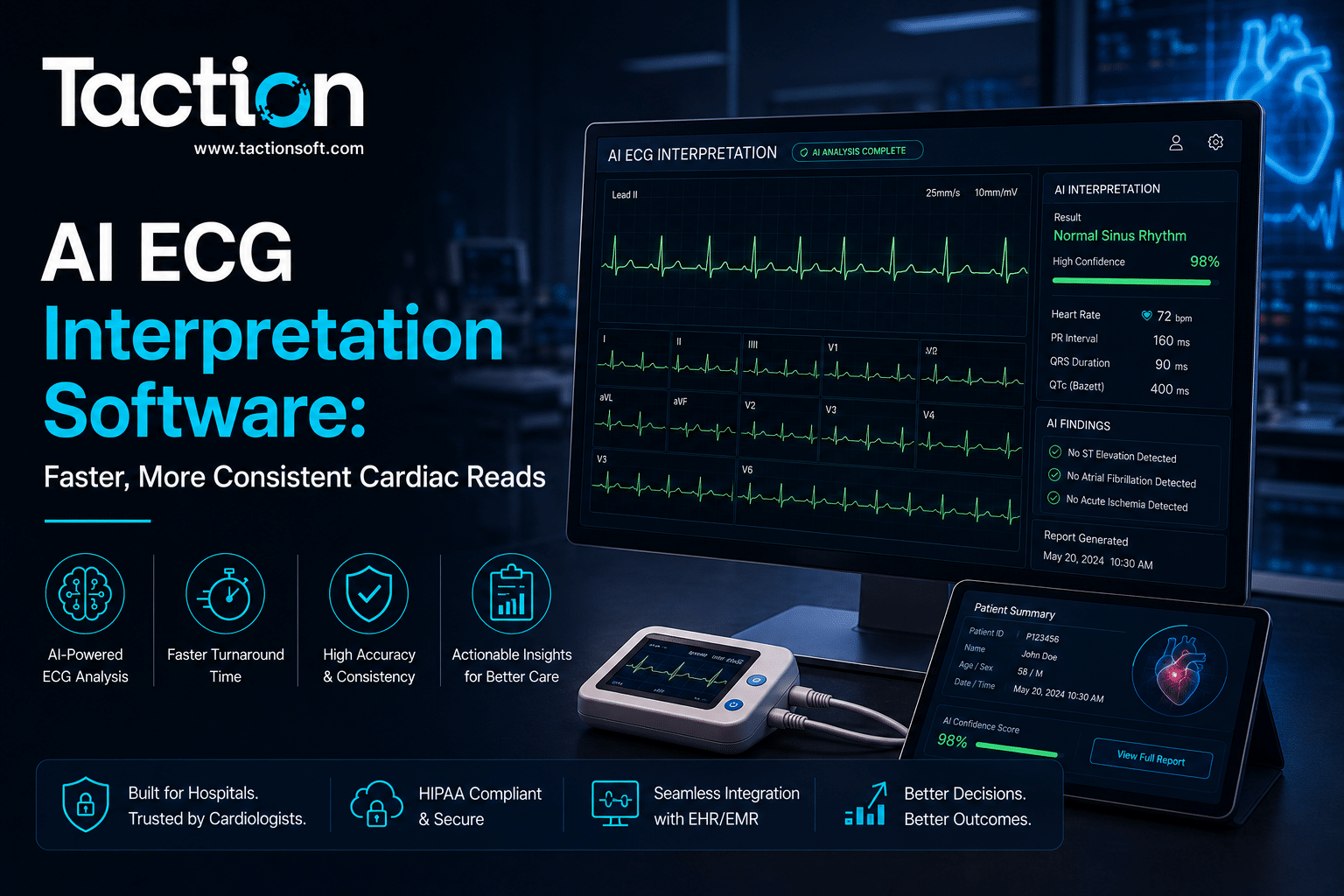
AI ECG interpretation software analyzes electrocardiogram waveforms to detect arrhythmias, conduction abnormalities, and subtle patterns associated with structural heart disease, often faster and more consistently than standard rule-based ECG machine algorithms that have changed little in decades. Emergency departments, cardiology clinics, and remote monitoring programs all generate enormous volumes of ECG data, and the bottleneck has rarely been recording the waveform, it has been getting a reliable, timely read on it, especially outside a fully staffed cardiology unit. This page covers how AI ECG interpretation differs from legacy machine algorithms, where it is being used clinically today, integration into cardiology and emergency workflows, and what to check before adopting a system.
How AI ECG Interpretation Differs From Legacy Algorithms
Most ECG machines already print an automated interpretation at the top of the strip, but that output comes from decades-old rule-based logic, not modern machine learning.
Rule-Based Algorithms Versus Deep Learning Models
Legacy ECG machine algorithms apply fixed morphological rules, measuring intervals and comparing them against thresholds. AI interpretation models trained on deep learning instead learn patterns directly from millions of labeled waveforms, allowing them to detect subtler signals, such as early indicators of reduced ejection fraction or occult atrial fibrillation, that are not captured by simple interval-based rules at all.
Detecting Conditions Not Visible to Rule-Based Systems
Some of the more clinically significant AI ECG applications go beyond arrhythmia detection entirely, identifying signals associated with conditions like low ejection fraction, electrolyte abnormalities, or even certain valve conditions from a standard 12-lead ECG, patterns that exist in the waveform but are invisible to both the human eye and traditional algorithmic thresholds.
Where AI ECG Interpretation Is Used Today
Adoption has concentrated in a few specific clinical settings where speed and consistency matter most.
Emergency Department Triage
In the emergency department, AI ECG interpretation helps triage chest pain patients faster by flagging high-risk patterns for immediate physician review, reducing the time between ECG acquisition and clinical decision-making during the critical early window of a suspected acute coronary event.
Remote and Ambulatory Monitoring
Continuous ambulatory monitors and wearable ECG patches generate far more data than a cardiologist can manually review strip by strip. AI interpretation is essential here simply to make the data volume usable, surfacing clinically significant events for review rather than requiring a technician to scan raw waveform data manually. This connects directly to the broader remote monitoring infrastructure covered in our work on cardiac RPM platform development, where AI-driven signal triage is a core requirement, not an optional add-on.
Primary Care and Point-of-Care Screening
Primary care settings without on-site cardiology support increasingly use AI-assisted ECG interpretation to get a same-visit read rather than waiting on overread from an offsite cardiologist, shortening the time to referral for patients who need specialist follow-up.
Integration Into Cardiology and Telehealth Workflows
Getting AI ECG interpretation into daily clinical use requires connecting it to the systems that already capture and store waveform data.
Connecting to ECG Carts and EHR Systems
The interpretation engine needs a reliable data pipeline from the ECG cart or monitor into the analysis system and back into the EHR as a structured, timestamped result, ideally without requiring staff to manually upload or transfer files between disconnected systems.
Supporting Telecardiology Programs
For health systems running telecardiology programs across rural or underserved sites, AI interpretation provides a first-pass read that supports the remote cardiologist’s overread rather than replacing it, which speeds up the overall consult cycle particularly when volume is high. Our work on telecardiology platform development covers how this fits into a broader remote cardiology service model.
Regulatory Status and Clinical Validation
Not all AI ECG claims carry the same regulatory weight, and buyers should understand the difference before relying on a system clinically.
FDA Clearance for Specific Conditions
FDA clearance for AI ECG interpretation is typically granted for specific detection tasks, atrial fibrillation detection, low ejection fraction screening, and so on, rather than a blanket clearance for general ECG interpretation. Confirm which specific conditions a system is cleared to detect before relying on it for anything beyond that scope.
Validation Against Diverse Patient Populations
ECG waveform characteristics vary by age, sex, and underlying comorbidities, and models validated predominantly on one demographic can underperform on others. Ask vendors directly what population their validation studies covered before assuming performance transfers to your specific patient base.
Key Takeaways
AI ECG interpretation software moves beyond legacy rule-based algorithms to detect subtler cardiac signals, and it has clear clinical value in emergency triage, remote monitoring, and primary care settings without on-site cardiology support. Success depends on confirming the specific FDA-cleared use case, validating performance against your own patient population, and integrating cleanly into existing ECG carts and EHR pipelines rather than adding a disconnected manual step. If your organization is exploring AI ECG interpretation, reach out to our team to discuss your current cardiology and monitoring infrastructure.
Frequently Asked Questions
Is AI ECG interpretation more accurate than the standard machine reading on an ECG printout?
For many arrhythmia and structural heart disease indicators, yes, AI models trained on deep learning outperform the rule-based algorithms built into standard ECG machines, particularly for subtler patterns not captured by interval-based thresholds.
Can AI ECG interpretation detect conditions beyond arrhythmias?
Some FDA-cleared systems can flag signals associated with reduced ejection fraction, certain electrolyte abnormalities, and other structural indicators directly from a standard 12-lead ECG, in addition to arrhythmia detection.
Does AI ECG interpretation replace a cardiologist’s overread?
No. Even in emergency and remote monitoring settings, AI-flagged findings are intended to support faster triage and prioritization, with a qualified clinician confirming the final interpretation.
How does AI ECG interpretation work with wearable and ambulatory monitors?
It processes continuous waveform data from patches or wearable monitors and surfaces clinically significant events for clinician review, making high-volume continuous monitoring data practically usable.
What should we check before adopting an AI ECG interpretation system?
Confirm the specific FDA-cleared conditions covered, the patient population used in validation studies, and how the system integrates with your existing ECG carts, monitors, and EHR reporting pipeline.