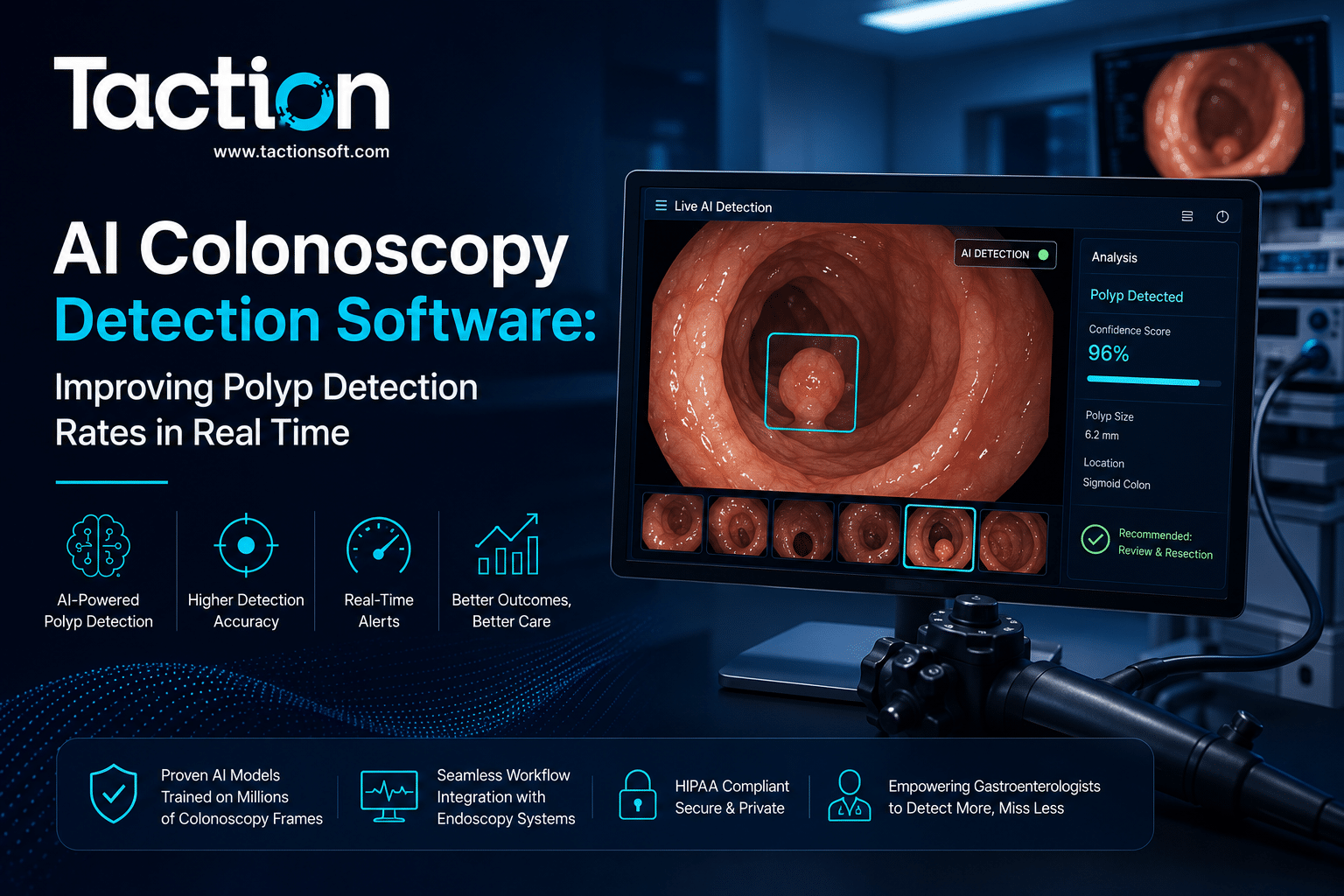
AI colonoscopy detection software is designed to help gastroenterologists catch polyps that are easy to miss during a live procedure, using real-time computer vision to highlight suspicious tissue directly on the endoscopy monitor as the scope moves through the colon. Missed polyps are one of the leading contributors to interval colorectal cancer, cases diagnosed between screening intervals, and even experienced endoscopists have documented miss rates that real-time detection systems are specifically built to reduce. This page covers how these systems work during a live procedure, what the clinical evidence actually shows, integration considerations for endoscopy suites, and what to evaluate before adopting one.
How Real-Time Polyp Detection Works During a Procedure
Unlike diagnostic imaging AI that processes a static study after the fact, colonoscopy detection software runs inference on live video feed, frame by frame, while the endoscopist is actively navigating the colon.
Frame-by-Frame Computer Vision Analysis
The system processes each video frame from the endoscope in near real time, using models trained on large annotated datasets of polyp and non-polyp tissue, and overlays a visual marker, often a bounding box or highlight, on the monitor the moment a suspicious region is detected. This happens with minimal latency so it does not disrupt the natural pace of the procedure.
Distinguishing Detection From Characterization
Detection software tells the endoscopist where to look. Characterization software goes a step further and estimates whether a detected polyp is likely adenomatous or hyperplastic, informing decisions on resection versus surveillance. Some platforms combine both functions, others focus on detection alone and leave characterization to clinical judgment, which is an important distinction when evaluating vendors.
What the Clinical Evidence Shows
Adoption of AI-assisted colonoscopy has moved faster than in most other AI-in-imaging categories because the clinical trial evidence is comparatively strong.
Adenoma Detection Rate Improvements
Multiple randomized trials have shown measurable increases in adenoma detection rate when AI assistance is used compared to standard colonoscopy alone, particularly benefiting smaller and flatter polyps that are more likely to be overlooked visually. This is the primary outcome measure gastroenterology departments track when justifying adoption.
Procedure Time and Withdrawal Rate Considerations
Some studies note a modest increase in withdrawal time when using detection software, since endoscopists pause more often to evaluate flagged regions. Departments planning capacity around AI adoption should factor this into scheduling rather than assuming procedure throughput stays flat.
Integration Into the Endoscopy Suite
Getting detection software into daily use requires more than plugging in a box next to the endoscopy tower.
Compatibility With Existing Endoscopy Hardware
Most systems are built to interface with standard video output from major endoscope manufacturers, but compatibility should be confirmed against your specific tower and processor model before purchase, since older equipment sometimes requires an adapter or is not supported at all.
Workflow and Documentation Integration
Beyond the live overlay, the more useful implementations also log detected findings into the procedure report automatically, reducing manual documentation and creating a more consistent record across endoscopists for quality tracking purposes. This ties into the same category of automation covered in our broader work on computer vision for medical imaging, where structured, auditable outputs matter as much as the detection itself.
Evaluating Vendors and Regulatory Status
Before committing to a system, gastroenterology departments should look past the marketing claims and into the underlying validation.
FDA Clearance Scope
Confirm the specific FDA clearance covers detection, characterization, or both, and check what patient population and colonoscope models the clearance study actually used. A clearance for detection alone does not extend to characterization claims a vendor might make informally in sales conversations.
Training Data Diversity
Ask how diverse the training dataset was across bowel prep quality, polyp morphology, and patient demographics. Systems trained predominantly on well-prepped, high-quality video tend to underperform in real-world conditions with variable bowel prep, which is common in general practice.
Cost and Deployment Planning
Departments evaluating AI colonoscopy tools should model cost against procedure volume rather than treating it as a flat software fee. High-volume endoscopy centers see faster ROI from improved detection rates translating into fewer missed diagnoses and reduced downstream liability exposure, while lower-volume practices may find the economics harder to justify without a broader digital health strategy. Teams weighing this investment against other imaging AI priorities can review our broader analysis of AI development costs across healthcare use cases to compare relative investment levels.
Key Takeaways
AI colonoscopy detection software improves adenoma detection rates by flagging suspicious tissue in real time during the procedure, with the strongest clinical evidence currently supporting detection over characterization claims. Successful adoption depends on confirming hardware compatibility, understanding the FDA clearance scope precisely, and planning for a modest increase in withdrawal time rather than assuming flat throughput. If your endoscopy program is evaluating this technology, schedule a consultation to walk through your current endoscopy tower setup and procedure volume.
Frequently Asked Questions
Does AI colonoscopy detection software replace the endoscopist’s judgment?
No. The software flags suspicious regions for the endoscopist to evaluate. The decision to biopsy, resect, or continue surveillance remains entirely with the clinician performing the procedure.
Does using AI detection software slow down colonoscopy procedures?
Clinical studies have shown a modest increase in withdrawal time in some cases, as endoscopists pause to assess flagged regions, though this varies by system and operator experience with the tool.
Is AI colonoscopy detection software FDA cleared?
Several systems have received FDA clearance for real-time polyp detection. Clearance scope varies by vendor, and detection clearance does not automatically imply clearance for characterization claims.
Will this software work with our current endoscopy equipment?
Compatibility depends on your specific endoscope tower and video processor model. Confirm compatibility directly with the vendor or your development partner before purchasing.
How is polyp detection accuracy measured in these systems?
Accuracy is typically reported through adenoma detection rate improvements measured against a control arm in clinical trials, alongside sensitivity and false positive rate metrics reported per procedure.