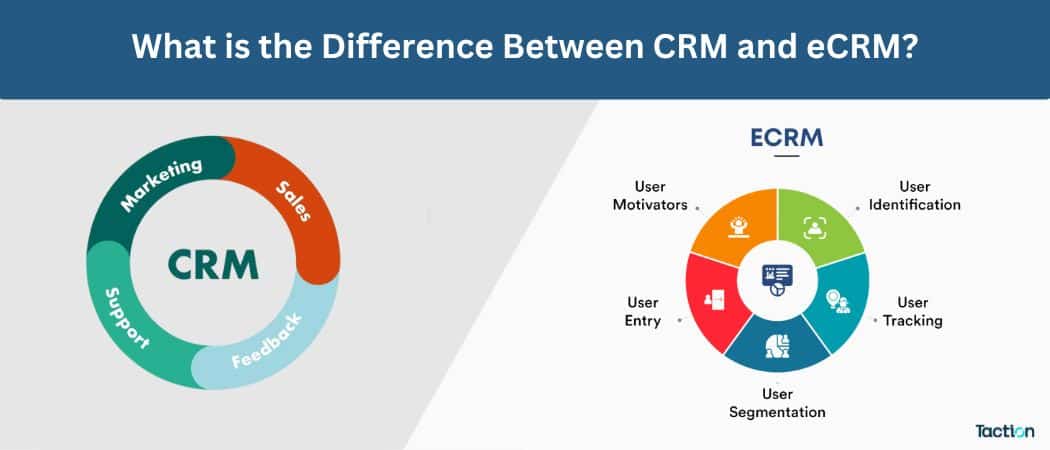
CRM vs eCRM in one paragraph: CRM (Customer Relationship Management) manages an organization's relationships across the full customer lifecycle — often through internal staff and including offline touchpoints like phone, mail, and in-person. eCRM (Electronic CRM) is its digital-first evolution: customers engage directly through web, mobile, email, and social channels, with data captured automatically in real time and personalization driven by AI.
The short version: CRM is the broader discipline; eCRM is the digital, customer-facing layer built on top of it — and most modern organizations run both, integrated.
CRM and eCRM are used interchangeably all the time — and that confusion quietly costs companies money in mis-scoped projects, duplicated data, and the wrong architecture. The two are related but not the same: one is the discipline of managing customer relationships; the other is the digital, real-time, customer-facing system built to deliver it. For anyone making a system-design, integration, or vendor decision, the difference is architectural, not academic — and getting it wrong shows up in your roadmap, your data governance, and your customer experience.
For technology decision-makers, IT architects, and business leaders, understanding the precise differences between CRM and eCRM is not just academic — it directly impacts your system design, integration roadmap, data governance strategy, and customer experience outcomes.
At Taction Software, we specialize in building intelligent, scalable, and integration-ready CRM and eCRM platforms for businesses across verticals. This guide offers a technically rigorous, in-depth comparison to help your team make the right architectural and strategic decision.
Understanding CRM — Architecture, Function, and Scope
What is CRM?
internal-facing, relationship management across all channels (including offline), often agent-mediated.
At its core, a CRM system is a centralized data repository coupled with workflow automation tools, enabling teams to:
- Capture and manage customer contact data and interaction history
- Track leads through structured sales pipelines
- Log service requests, complaints, and resolutions
- Coordinate internal team tasks and follow-ups
- Generate analytical reports on sales performance and customer behavior
Traditional CRM Architecture
Traditional CRM systems follow a client-server or on-premise architecture:
- Database Layer: Relational databases (typically SQL-based — Oracle, MS SQL Server, MySQL) store structured customer records.
- Application Layer: Business logic handles workflows, automation rules, and process orchestration.
- Presentation Layer: Desktop GUI or thick-client applications used by internal staff.
- Integration Layer: APIs or middleware for connecting with ERP, billing, or communication tools.
The critical characteristic of traditional CRM is that customers never interact with the system directly. All data entry, updates, and relationship management are handled by internal agents — sales reps, support staff, account managers.
CRM Modules — What’s Typically Included?
A well-architected CRM platform typically comprises:
- Contact & Account Management — master records for individuals and organizations
- Sales Force Automation (SFA) — lead scoring, opportunity tracking, pipeline visualization
- Customer Service & Support — ticket management, SLA tracking, case escalation
- Marketing Automation — campaign management, segmentation, email scheduling
- Analytics & Reporting — dashboards, KPIs, forecasting models
- Workflow Engine — rule-based automation for task assignment and notifications
Our custom CRM development services at Taction Software are architected to include all these modules while remaining modular and extensible for future integrations.
Understanding eCRM — Digital-First Relationship Management
What is eCRM?
customer-facing, digital-only channels (web, mobile, email, social), self-service and real-time.
eCRM is not simply “CRM hosted in the cloud.” It represents a paradigm shift in customer engagement architecture, where:
- Customers interact directly with systems through self-service portals, web apps, and mobile interfaces
- Behavioral and transactional data is captured automatically, in real time
- Personalization engines dynamically tailor content and offers based on digital footprints
- Multichannel orchestration ensures consistent experiences across web, email, social, and mobile
eCRM Architecture
eCRM systems are inherently distributed, cloud-native, and API-first:
- Frontend Layer: Web portals, Progressive Web Apps (PWAs), mobile apps — customer-facing interfaces for self-service and engagement
- API Gateway: RESTful or GraphQL APIs enabling real-time data exchange between frontend, backend, and third-party services
- Microservices Backend: Decoupled services for notifications, authentication, personalization, analytics, and workflow management
- Event-Driven Messaging: Message brokers (Kafka, RabbitMQ) enabling asynchronous, real-time event processing (e.g., triggering an email when a user abandons a cart)
- Data Lake / Warehouse: Unified storage for structured and unstructured behavioral data feeding ML models
- AI/ML Layer: Recommendation engines, predictive churn models, sentiment analysis, and next-best-action algorithms
- Integration Hub: Connectors for email platforms, SMS gateways, social media APIs, payment gateways, and ERP systems
Key eCRM Capabilities
- Omnichannel Engagement: Unified customer profile across web, mobile, email, social, and in-store
- Real-Time Behavioral Tracking: Clickstream analysis, session recording, heatmaps feeding CRM profiles
- Marketing Automation 2.0: Trigger-based journeys driven by real-time events, not just schedules
- Customer Self-Service Portals: Account management, order tracking, support ticketing — all without agent involvement
- Predictive Analytics: AI-driven scoring for churn risk, lifetime value, upsell potential
- Chatbots & Conversational AI: 24/7 automated engagement with NLP-powered interfaces
CRM vs. eCRM — A Technical Comparison
eCRM is the digital front door; CRM is the operational engine behind it. Integrated, they share one unified customer profile.
| Dimension | CRM | eCRM |
|---|---|---|
| Architecture | Client-server / on-premise | Cloud-native / microservices / API-first |
| Customer Interaction | Indirect (via agents/staff) | Direct (self-service portals, apps) |
| Primary Channels | Phone, in-person, mail, fax | Web, email, mobile, social, chatbot |
| Data Entry | Manual by internal staff | Automated via behavioral tracking |
| Data Processing | Batch (periodic) | Real-time / event-driven |
| Personalization | Rule-based, limited | AI/ML-driven, dynamic |
| Scalability | Vertical scaling (hardware) | Horizontal scaling (cloud infra) |
| Deployment Model | On-premise or licensed | SaaS / cloud / hybrid |
| Accessibility | Internal teams only | Customers + staff, 24/7 globally |
| Integration Complexity | Moderate (point-to-point) | High (API ecosystem, event buses) |
| Analytics Capability | Descriptive (historical reports) | Predictive & prescriptive (AI/ML) |
| Customer Data Scope | Structured, transaction-based | Structured + unstructured behavioral |
| Compliance Considerations | Standard data protection | GDPR, CCPA, industry-specific (HIPAA) |
| Update Frequency | Periodic releases | Continuous deployment (CI/CD) |
Healthcare — The Most Complex and Critical Use Case
Healthcare is where the CRM vs. eCRM distinction becomes most consequential. Patient relationship management carries unique technical, regulatory, and operational demands that standard enterprise CRM platforms are simply not designed to address out of the box.
CRM in Healthcare: Managing the Patient Journey
CRM in hospitals has evolved from basic contact management into a comprehensive patient relationship management (PRM) ecosystem. Healthcare CRM systems help:
- Patient Acquisition & Referral Management: Track referral sources, manage physician relationships, and analyze geographic patient acquisition patterns
- Appointment Scheduling & Follow-Up Automation: Reduce no-shows through automated reminders via SMS, email, or voice calls
- Care Coordination: Enable multi-disciplinary care teams to share patient context and coordinate handoffs
- Post-Discharge Engagement: Automated follow-up workflows to monitor recovery, medication adherence, and readmission risk
- Population Health Management: Segment patient populations by diagnosis, risk score, or demographics to drive proactive outreach
- Patient Satisfaction Tracking: Survey automation (HCAHPS, Press Ganey) integrated with CRM records
Healthcare CRM differs from commercial CRM in several critical ways:
- Data is governed by HIPAA (Health Insurance Portability and Accountability Act) in the US and equivalent regulations globally, requiring strict access controls, audit logs, and encryption at rest and in transit
- Patient records must integrate with Electronic Health Records (EHR) systems like Epic, Cerner, or Allscripts
- Workflows must accommodate clinical decision-making, not just sales or service processes
- Data models must handle medical coding standards — ICD-10, CPT, SNOMED CT, LOINC
eCRM in Healthcare: The Digital Patient Experience
Healthcare eCRM extends these capabilities into the digital domain, empowering patients to actively manage their healthcare relationships online. Key capabilities include:
- Patient Portals: Secure web/mobile portals for accessing records, lab results, invoices, and care summaries
- Online Appointment Booking & Teleconsultation: Integrated scheduling with real-time provider availability
- Automated Health Journey Campaigns: Trigger-based messaging (e.g., diabetes management reminders, vaccination due alerts)
- Consent Management: Digital consent workflows compliant with HIPAA and regional regulations
- Chronic Disease Management Programs: Wearable and IoT device data feeding into CRM profiles for proactive intervention
- Chatbot-Driven Symptom Triage: AI-powered pre-consultation assistants reducing front-desk load
HL7, FHIR, and Mirth Connect: The Integration Backbone of Healthcare eCRM
No discussion of healthcare eCRM is complete without addressing the interoperability layer. Healthcare data does not exist in isolation — it lives across EHRs, laboratory systems, radiology platforms, pharmacy systems, and insurance portals. Moving this data securely and accurately requires standardized messaging protocols.
HL7 (Health Level Seven) is the global standard for the exchange, integration, sharing, and retrieval of electronic health information. HL7 v2.x remains the most widely deployed messaging standard in hospitals, while HL7 FHIR (Fast Healthcare Interoperability Resources) is the modern, RESTful successor designed for API-first healthcare ecosystems.
Mirth Connect is an open-source, cross-platform healthcare integration engine that enables healthcare organizations to route, transform, filter, and translate HL7 messages between disparate systems. It acts as the middleware backbone of a healthcare eCRM integration architecture.
For organizations implementing healthcare eCRM with HL7 and Mirth Connect integration, the technical workflow typically looks like this:
- A patient registers on the eCRM portal → triggers an ADT (Admit, Discharge, Transfer) message in HL7 format
- Mirth Connect receives, validates, and transforms the HL7 message
- The transformed data is routed to the EHR (e.g., Epic), billing system, and CRM patient record simultaneously
- CRM workflows trigger automated welcome communications, consent collection, and appointment scheduling
- Post-visit, lab results from the LIS (Laboratory Information System) are pushed via HL7 ORU messages back through Mirth Connect into the patient portal
This architecture ensures zero data silos, real-time patient record synchronization, and a seamless digital patient experience — all while maintaining HIPAA-compliant data handling.
Key Technical Considerations for Healthcare eCRM Implementation
- Role-Based Access Control (RBAC): Granular permissions ensuring clinicians, administrators, and patients see only what they’re authorized to access
- End-to-End Encryption: TLS 1.3 in transit, AES-256 at rest for all PHI (Protected Health Information)
- Audit Trail & Logging: Every data access and modification event logged with timestamp, user ID, and IP — mandatory for HIPAA compliance
- Data Residency: Cloud infrastructure must support region-locked data storage where required
- SMART on FHIR: OAuth 2.0-based authorization framework for secure third-party app integration with EHRs
- Disaster Recovery & High Availability: 99.9%+ uptime SLAs with automated failover for patient-critical systems
Which one does your business actually need?
Choose a traditional CRM if:
- Your customer interactions are mostly agent-driven (sales reps, account managers, support staff)
- Your primary channels are phone, email, and in-person
- Your core need is internal: pipeline management, contact records, service ticketing, and reporting
Add an eCRM layer if:
- You need customer self-service — portals, account management, online booking, order tracking
- You want automated, real-time engagement across web, mobile, and social (not just scheduled campaigns)
- You’re after AI-driven personalization, behavioral tracking, and predictive analytics at scale
You need both, integrated, if (the most common answer):
- You serve customers across both digital and human-assisted channels and want a single unified profile
- You’re scaling and can’t afford data silos between your customer-facing apps and your internal teams
- In healthcare specifically: patient portals, online scheduling, and digital outreach (eCRM) must stay in sync with care-team coordination, referral management, and EHR workflows (CRM) — which is why the HL7/Mirth integration layer described below isn’t optional, it’s the connective tissue.
The trap to avoid: treating eCRM as “just moving the CRM to the cloud.” It isn’t a hosting choice — it’s a different interaction model. Buying cloud CRM and assuming you now have eCRM leaves you with no real self-service, no real-time behavioral data, and a customer experience that still depends on a staff member typing things in.
Implementation Roadmap — CRM to eCRM Migration
For organizations running legacy CRM systems and considering a migration or augmentation toward eCRM capabilities, here is a high-level technical roadmap:
Phase 1 — Audit & Architecture Design Assess existing CRM data models, integration points, and technical debt. Define target eCRM architecture including cloud infrastructure, API strategy, and data governance framework.
Phase 2 — Data Migration & Cleansing Extract, transform, and load (ETL) legacy CRM data into the new platform. Deduplicate records, standardize data formats, and establish master data management (MDM) policies.
Phase 3 — API & Integration Layer Development Build RESTful APIs and integration connectors for EHR, ERP, marketing platforms, and communication gateways. Implement event-driven messaging architecture.
Phase 4 — Frontend & Self-Service Portal Development Design and develop customer/patient-facing web and mobile interfaces. Implement SSO (Single Sign-On), MFA (Multi-Factor Authentication), and consent management flows.
Phase 5 — Analytics & AI Layer Integrate business intelligence tools, build predictive models, and configure real-time dashboards for operational and clinical decision-makers.
Phase 6 — Testing, Compliance & Go-Live Conduct penetration testing, load testing, HIPAA/GDPR compliance audits, and UAT (User Acceptance Testing) before phased production rollout.
Our team at Taction Software manages end-to-end CRM and eCRM implementation engagements, from architecture blueprinting to post-launch support.
Final Thought
CRM and eCRM are not alternatives.
They serve different purposes.
CRM keeps your internal operations structured.
eCRM connects those operations to real-world user interaction.
If you’re building for scale, you need both working together.
The right choice — and the right implementation partner — can make the difference between a system that merely stores data and one that actively drives better outcomes.
Connect with the Taction Software team to discuss your CRM or eCRM requirements. Our architects and engineers are ready to design a solution built for your industry, your scale, and your future.
© Taction Software — Engineering Intelligent Customer & Patient Relationship Platforms
Frequently Asked Questions (FAQ)
No. While eCRM is typically cloud-hosted, the distinction is architectural and functional, not just about deployment model. eCRM enables direct customer interaction, real-time data processing, AI-driven personalization, and omnichannel engagement — capabilities that go far beyond simply hosting a CRM in the cloud.
Yes, and most enterprise organizations do. A traditional CRM manages internal workflows, sales pipelines, and agent-driven processes, while eCRM handles customer-facing digital touchpoints. The two systems are typically integrated through APIs to maintain a unified customer profile.
HL7 provides the standardized messaging format for exchanging clinical data between healthcare systems. In a healthcare eCRM context, HL7 messages enable patient data to flow securely between the eCRM platform, EHR, laboratory systems, billing platforms, and patient portals — ensuring consistent and accurate records across all touchpoints.
Mirth Connect serves as the integration engine that routes, translates, and transforms HL7 messages between disparate healthcare systems. It is a critical middleware component that enables healthcare eCRM platforms to communicate with legacy EHR systems that may not support modern RESTful APIs.
Key requirements include: encryption of all PHI at rest and in transit, role-based access controls, comprehensive audit logging, business associate agreements (BAAs) with all third-party vendors, patient consent management, and breach notification procedures. Any healthcare eCRM platform must be designed with these requirements embedded at the architectural level — not as an afterthought.
Timelines vary significantly based on organizational size, data complexity, and integration requirements. A mid-sized healthcare organization can expect a phased migration to take 6–18 months. Taction Software’s engagement model includes detailed project scoping to provide accurate timelines before any development begins.
Patient Relationship Management (PRM) is a healthcare-specific term that mirrors eCRM concepts but is tailored to clinical workflows, patient journeys, and regulatory requirements. PRM platforms are essentially healthcare eCRM systems built with HIPAA compliance, EHR integration, and clinical data models at their core.
Yes. Taction Software develops fully custom CRM and eCRM solutions for healthcare providers, hospitals, clinics, and health-tech companies — including HL7/FHIR integration, Mirth Connect configuration, patient portal development, and HIPAA-compliant cloud infrastructure.