Project Overview
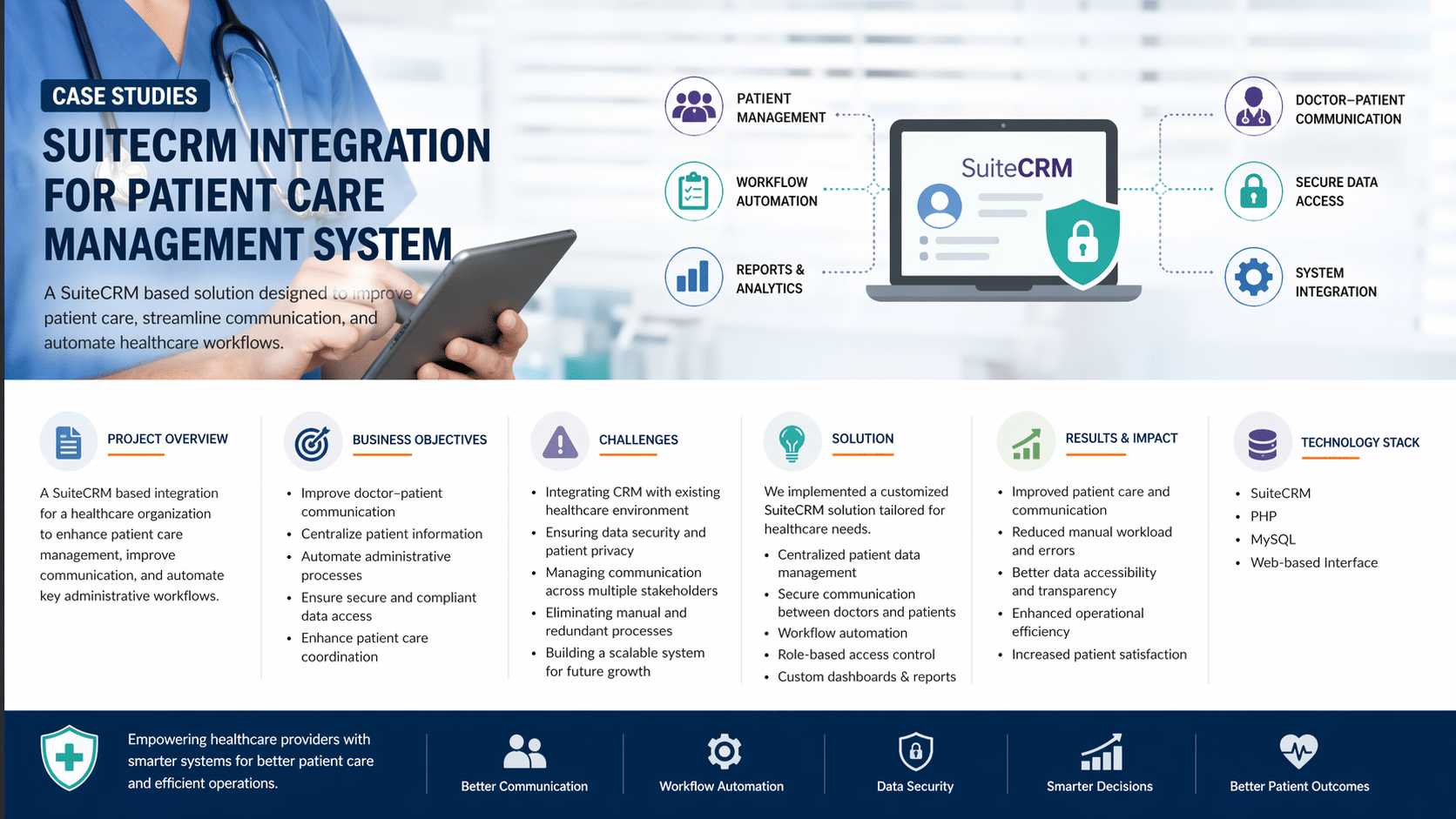
Healthcare providers require efficient systems to manage patient relationships, streamline workflows, and ensure secure communication. The client needed a centralized platform that could connect doctors, patients, and administrative staff while improving operational efficiency.
The objective was to build a scalable solution that enhances patient care through automation—similar to how advanced healthcare software development solutions optimize clinical workflows and data management.
Business Objectives
The client aimed to:
- Improve communication between doctors and patients
- Centralize patient data and healthcare workflows
- Automate routine administrative processes
- Enable secure and compliant data access
- Enhance overall patient care coordination
This aligns with modern approaches in healthcare product development, where integrated systems improve efficiency and outcomes.
Challenges
The project presented several challenges:
- Integrating CRM capabilities into an existing healthcare environment
- Ensuring secure handling of sensitive patient data
- Managing communication across multiple stakeholders
- Avoiding workflow delays caused by manual processes
- Maintaining system scalability for future expansion
These are common challenges in HIPAA-compliant software development, where security and compliance are critical.
Solution
We implemented a customized SuiteCRM-based solution tailored for healthcare use cases.
Key features included:
- Centralized patient data management system
- Secure communication between doctors and patients
- Workflow automation for administrative processes
- Role-based access control for data security
- Integrated dashboards for monitoring and reporting
The system architecture followed best practices similar to custom app development, ensuring flexibility and seamless integration.
Technology Stack
- SuiteCRM
- PHP
- MySQL
- Web-based Interface
Results and Impact
The solution delivered measurable improvements:
- Improved doctor-patient communication efficiency
- Reduced manual administrative workload
- Enhanced data accessibility and workflow transparency
- Better coordination across healthcare teams
- Increased operational efficiency and patient satisfaction
This transformation reflects the impact of well-designed systems similar to custom software development solutions, where automation drives efficiency and scalability.
Conclusion
This case study demonstrates how SuiteCRM can be effectively integrated into healthcare systems to improve patient care and operational efficiency. By centralizing communication, automating workflows, and ensuring secure data handling, the solution enabled a more connected and efficient healthcare ecosystem.
For organizations exploring similar solutions, integrating CRM with healthcare systems is a key step toward digital transformation—just like modern real-time monitoring systems used in advanced platforms such as your traffic enforcement solution.