Why PHI Anonymization Matters When Using ChatGPT in Healthcare
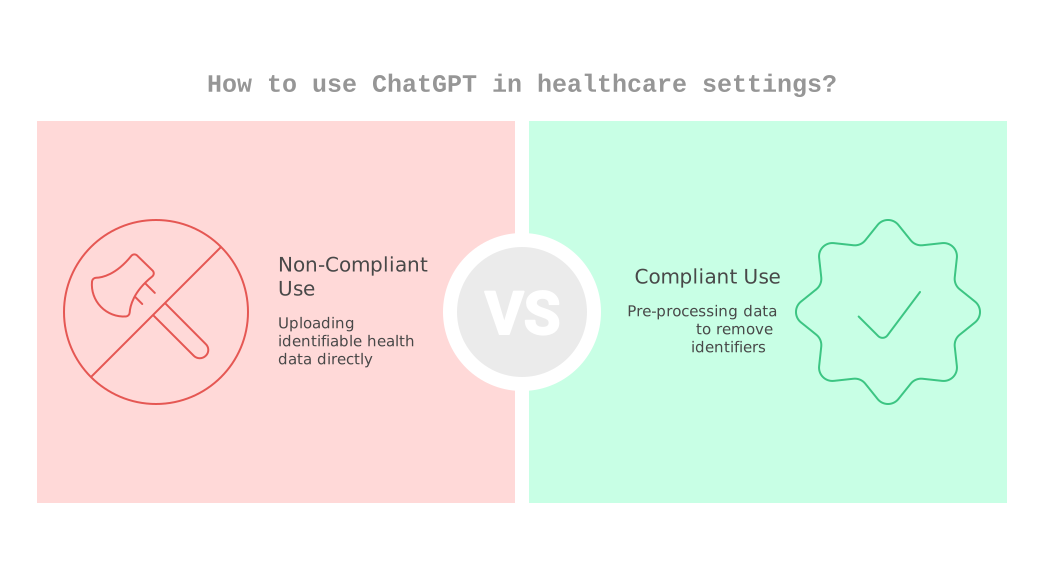
No, you cannot put identifiable PHI into the public version of ChatGPT — OpenAI does not offer HIPAA coverage for it, and no Business Associate Agreement (BAA) is available on the consumer product. You can use it safely if every input is de-identified to HIPAA’s Safe Harbor or Expert Determination standard first. This guide gives you the actual 18-identifier checklist, a worked before/after example, a tool comparison, and a reference pipeline you can build. The hard part isn’t the obvious identifiers — it’s the quasi-identifiers (rare diagnosis + small ZIP + a date) that re-identify a patient even after the names are gone. That’s what most teams get wrong.
With the increasing adoption of AI tools like ChatGPT in clinical documentation, scheduling support, and care coordination, it’s tempting to rely on these systems for efficiency. But without proper safeguards, entering raw PHI into ChatGPT could mean exposing sensitive health data to platforms that aren’t HIPAA-compliant.
The consequences aren’t just theoretical—real-world breaches have occurred from uploading unmasked patient notes to AI tools. That’s why anonymizing PHI before any AI interaction isn’t optional—it’s critical for regulatory compliance and patient trust.
HIPAA Privacy Rule
Can you use ChatGPT with PHI at all?
Three tiers, and the distinction matters because teams keep conflating them:
Product | BAA available? | Can it touch PHI? | Notes |
ChatGPT (free / Plus consumer) | No | Never — even “low-risk” snippets | Inputs may be retained/used per consumer terms unless settings restrict; no covered-entity coverage |
ChatGPT Enterprise / Team | Sometimes — confirm in writing | Only under a signed BAA and with your own controls | A BAA is necessary but not sufficient; you still own de-identification, access control, and logging |
OpenAI API (with BAA) | Yes, on request for eligible accounts | Yes, within the BAA’s scope | Most production healthcare integrations live here, behind a de-id layer |
The trap: a BAA does not de-identify your data. It allocates liability. You are still the covered entity (or business associate) responsible for what goes in. Confirm current BAA terms directly with OpenAI before relying on any of the above — vendor coverage changes.
So the safe default for any team that hasn’t signed and validated a BAA is simple: de-identify everything before it leaves your environment.
The five terms people use interchangeably (and shouldn't)
This is the single biggest source of compliance gaps. They are not synonyms.
Term | What it does | Reversible? | HIPAA de-identification? |
Anonymization | Permanently alters/removes data so re-identification is not reasonably possible | No | Yes (this is the goal) |
De-identification | The HIPAA term: meets Safe Harbor or Expert Determination | Effectively no | Yes (the legal standard) |
Pseudonymization | Replaces identifiers with reversible tokens (e.g., a key maps “Patient A” → real name) | Yes, with the key | No — still PHI if you hold the key |
Masking | Hides part of a value for display (e.g., ***-**-1199) | Often yes | No — display control, not de-id |
Encryption | Protects data in transit/at rest; the underlying data is unchanged | Yes, with the key | No — encrypted PHI is still PHI |
Why this matters for ChatGPT: pseudonymization, masking, and encryption all leave you holding (or able to recover) PHI. Only anonymization that meets a HIPAA de-identification standard takes the data outside HIPAA’s scope. If you pseudonymize and keep the mapping key, you have not de-identified anything — you’ve just renamed the risk.
Secure Your AI Workflows
Ensure HIPAA compliance before using ChatGPT—our experts are ready to help.
The two HIPAA de-identification methods — and when to use each
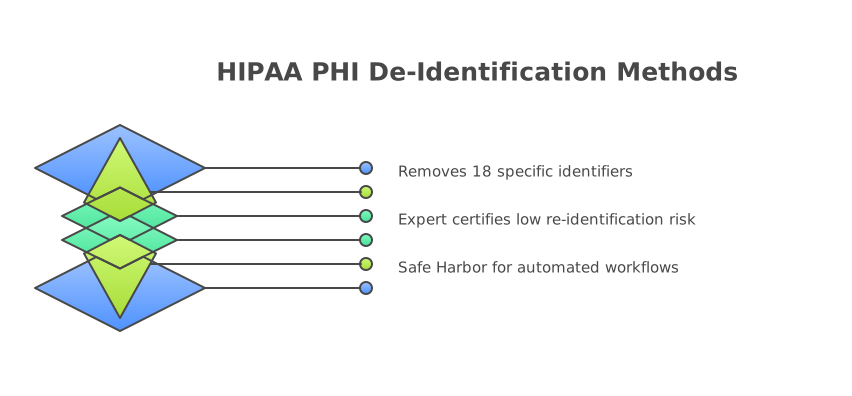
HIPAA gives you exactly two routes. Most teams default to Safe Harbor; the better answer depends on your data.
Safe Harbor | Expert Determination | |
How it works | Remove all 18 specified identifiers | A qualified statistician certifies re-identification risk is “very small” |
Speed | Fast, deterministic, automatable | Slower, requires an expert engagement |
Cost | Low (tooling + review) | Higher (expert fees, re-certification) |
Best for | High-volume, automated workflows; operational text; pipelines feeding ChatGPT | Research datasets, ML training, data you can’t fully strip without destroying utility |
Weakness | Blunt — strips useful context; still vulnerable to quasi-identifier re-identification if applied carelessly | Requires ongoing re-certification as conditions change |
Documentation needed | Record of the 18-identifier removal + “no actual knowledge” attestation | The expert’s methods and analysis, retained |
Practical rule: if you’re piping operational text into ChatGPT (summaries, draft messaging, coding support), use Safe Harbor + automation + human spot-check. If you need to preserve statistical utility for a model or study, get an Expert Determination — Safe Harbor will gut the dataset’s value.
The complete Safe Harbor checklist: all 18 identifiers
This is the part the average guide hand-waves. Here is the full list you actually have to clear. Treat it as a checklist your pipeline must pass.
- Names (patient, relatives, employers, household members)
- Geographic subdivisions smaller than a state — street address, city, county, precinct, ZIP. (The first three ZIP digits may be retained only if the combined population of that area is >20,000; otherwise they must be zeroed.)
- All dates directly related to an individual except the year — birth, admission, discharge, death, appointment, procedure dates. All ages over 89 and any date implying such age must be aggregated into a single “90+” category.
- Telephone numbers
- Fax numbers
- Email addresses
- Social Security numbers
- Medical record numbers (MRNs)
- Health plan beneficiary numbers
- Account numbers
- Certificate / license numbers
- Vehicle identifiers and serial numbers, including license plates
- Device identifiers and serial numbers
- Web URLs
- IP addresses
- Biometric identifiers — fingerprints, voiceprints
- Full-face photographs and any comparable images
- Any other unique identifying number, characteristic, or code — the catch-all that trips people up (e.g., an unusual tattoo description, a one-of-a-kind case detail)
Plus the standard most checklists omit: even after removing all 18, Safe Harbor requires that you have no actual knowledge the remaining information could identify the individual. That’s the bridge to the next section.
Get a Free PHI Risk Assessment
Let our team review your AI inputs for de-identification compliance.
Worked example: de-identifying a real clinical note
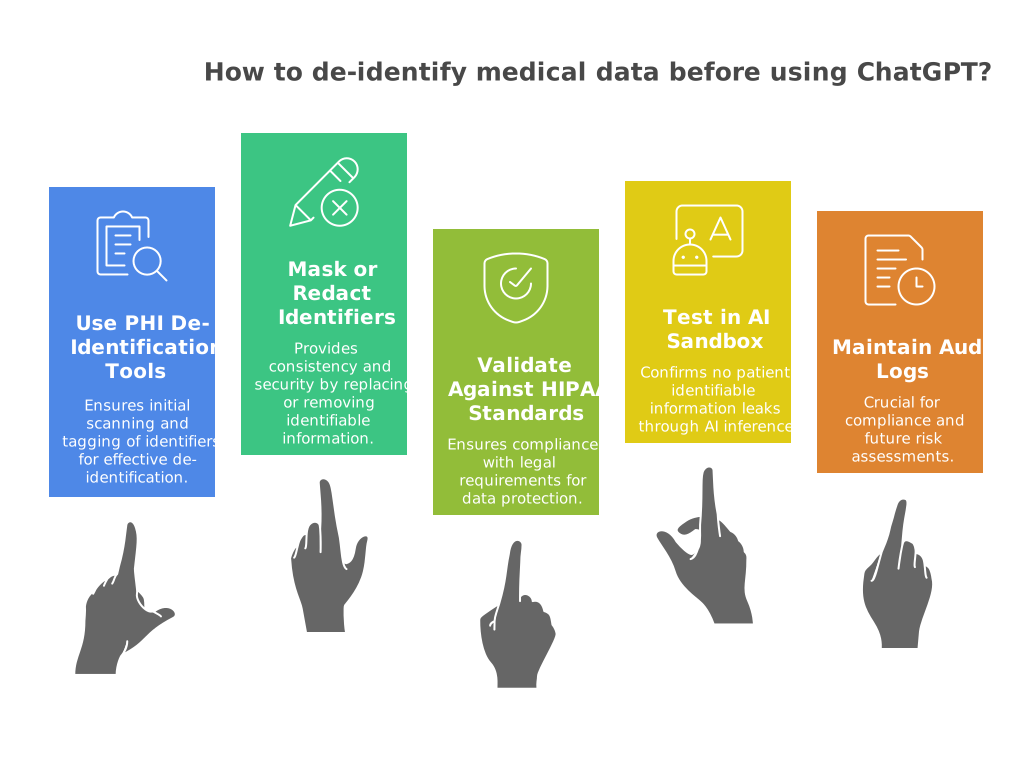
Theory is cheap. Here’s the work.
Raw note (contains PHI):
“John Smith, 67, MRN 4492187, seen 03/14/2026 at Mercy General Hospital (ZIP 10478, pop. ~4,100) for ongoing management of his ALS. Reachable at john.smith@email.com or 555-203-1199.”
Naive de-identification (what most automated passes produce — still risky):
“[NAME], 67, [MRN], seen [DATE] at [FACILITY] for ongoing management of his ALS. [EMAIL] / [PHONE].”
Looks clean. It is not safe. Two problems remain:
- ALS + ZIP 10478 (population ~4,100) is a quasi-identifier. A rare disease in a small geography can re-identify a single person even with every named field gone. This is the “no actual knowledge” clause biting.
The full ZIP survived, and the area is under the 20,000 threshold.
Correct Safe Harbor output:
“[PATIENT], age 67, [ID], seen [SHIFTED-DATE] at [FACILITY] for ongoing management of a progressive neuromuscular condition. Contact redacted.”
What changed and why:
- ZIP removed entirely (small-population area).
- Diagnosis generalized from a rare named disease to a category — this is the step automation alone misses.
- Date shifted consistently (preserve interval relationships without exposing the real date).
- Age 67 is fine; had it been 91, it would become “90+”.
Takeaway: automated tools clear identifiers 1–17 well. Identifier 18 and the “no actual knowledge” standard need a human who understands re-identification risk. Build that review step in.
Tooling: which PHI de-identification engine, and build vs. buy
There is no single “best” tool — the right choice is a function of your stack, data residency requirements, and volume. Compared on the dimensions that actually decide it:
Tool | Model | Data residency | Cost shape | Customizable | Best fit |
AWS Comprehend Medical (DetectPHI) | Managed API | Stays in your AWS account; HIPAA-eligible under AWS BAA | Pay-per-character | Limited | AWS-native pipelines wanting managed NER |
Microsoft Presidio | Open source, self-hosted | Never leaves your environment | Free (you run it) | Highly — custom recognizers, regex, NER | Teams needing control + zero external data sharing |
Philter | Open source / commercial, self-hosted | Self-hosted | Free / licensed | Moderate | Free-text clinical note redaction |
Google Cloud Healthcare API (De-ID) | Managed | In your GCP project; BAA available | Pay-per-use | Moderate | GCP-native, FHIR-aware workflows |
John Snow Labs (Spark NLP for Healthcare) | Licensed library | Self-hosted | Commercial license | High | High-volume clinical NLP, strong medical NER |
A note on accuracy: vendor benchmarks vary wildly by document type, and a tool that scores well on discharge summaries can miss badly on free-text chat logs. Validate any tool against a sample of your own data before trusting it — and never publish someone’s quoted precision/recall as if it applies to your corpus. (Honest expert framing beats a fabricated benchmark every time, and it’s also what the search engines now reward.)
Build vs. buy, in one line each:
- Buy/managed when you’re already in that cloud, volume is moderate, and you want someone else maintaining the model.
- Build/self-host (Presidio-based) when data residency is non-negotiable, you have custom identifier types, or per-call API cost at scale is prohibitive.
- Hybrid (the common production answer): self-hosted detection layer + human-in-the-loop review + audit logging, wrapped around the OpenAI API under a BAA.
Reference architecture: a de-identification layer in front of ChatGPT
For anything beyond ad-hoc use, you want a privacy layer the AI call cannot bypass:
- Ingest — raw text enters your environment only.
- Detect — NER + regex + checksum recognizers tag all 18 identifier classes.
- Transform — redact, or replace with consistent generic placeholders; generalize quasi-identifiers (diagnosis categories, banded ages, shifted dates).
- Review gate — human spot-check or risk-score threshold for high-sensitivity cases (rare conditions, small geographies).
- Send — only the cleaned payload reaches the OpenAI API (under BAA).
- Map back (optional) — re-insert tokens locally after the response returns, keeping the mapping key inside your environment, never in the prompt.
- Log — record what was detected, transformed, and sent, per request, for audit traceability.
The key design principle: the model never sees raw PHI, and the re-identification key never leaves your trust boundary.
The re-identification traps that cause most failures
- Quasi-identifiers. Rare disease + small ZIP + a date can pinpoint one person. Generalize, don’t just redact names.
- Date math. Stripping the day but leaving “admitted Monday, discharged Wednesday” plus a known event can reconstruct the date. Shift dates consistently instead.
- Free-text leakage. Identifiers hide in narrative (“the patient’s son, a firefighter at Station 12”). Structured-field redaction misses these; you need NLP on the prose.
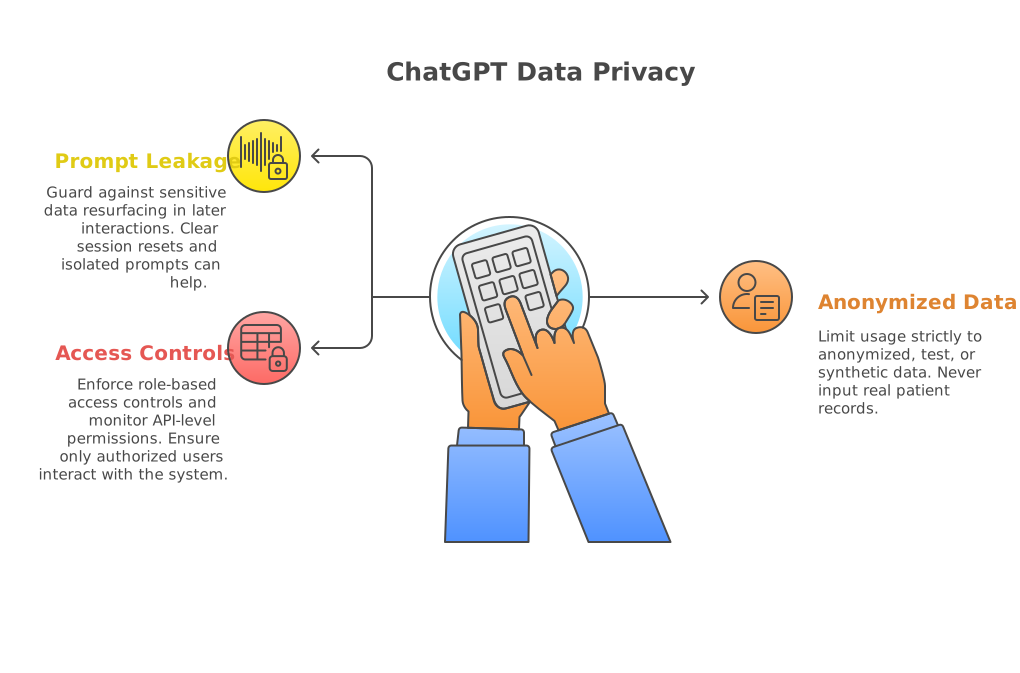
- Prompt/session bleed. PHI pasted earlier in a persistent chat can resurface later. Use isolated, stateless prompts; reset sessions.
- Re-identification by combination across prompts. Sending de-identified pieces separately that recombine into an identity. Govern at the dataset level, not per message.
Talk to a HIPAA AI Specialist
Book a 15-min call to explore secure AI integration for your healthcare app.
Governance and best practices
- Restrict AI workflows to anonymized, synthetic, or test data by default; treat raw PHI access as the exception requiring a signed BAA and controls.
- Enforce role-based access control and API-level permissions on the de-id layer.
- Keep audit logs of every de-identification action — tool, user, timestamp, what was transformed.
- Re-validate your pipeline whenever document types or models change; de-id accuracy drifts.
- Train staff: the most common breach is a person pasting a raw note into the consumer app “just this once.”
How Taction Software helps
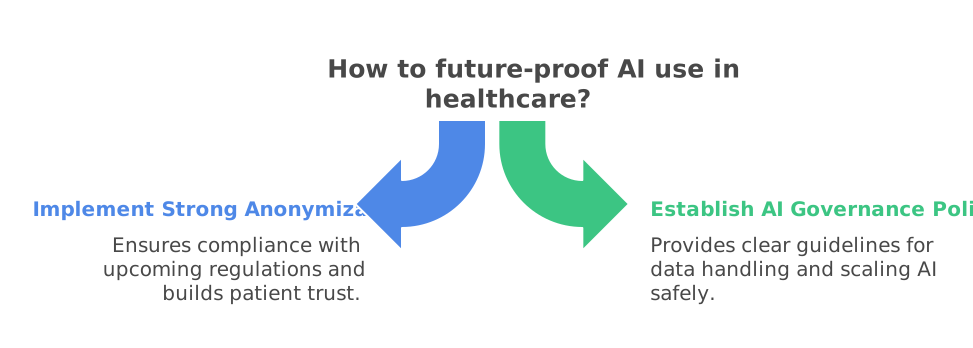
We build the de-identification layer described above as production infrastructure — not a one-off script. With [X]+ years in HIPAA-compliant healthcare IT, we design custom de-id pipelines around OpenAI’s API (under BAA), GPT-4-class models, and on-prem open-source models where data residency is non-negotiable. That includes Safe Harbor automation, Expert Determination support for research datasets, quasi-identifier handling, human-in-the-loop review gates, RBAC, and full audit logging.
FAQs
Not to the consumer product, and not to any OpenAI service without a signed, validated BAA and your own de-identification controls. The safe default is to de-identify everything before it leaves your environment.
A BAA is necessary but not sufficient. It allocates liability; it does not de-identify your data or build your access controls. You remain responsible for what you send.
Pseudonymization is reversible with a key you hold — so the data is still PHI. De-identification (Safe Harbor or Expert Determination) is effectively irreversible and takes the data outside HIPAA’s scope.
Safe Harbor for high-volume automated workflows; Expert Determination when you must preserve statistical utility (research, ML training). Safe Harbor will degrade dataset value.
AWS Comprehend Medical, Microsoft Presidio (open source), Philter, Google Cloud Healthcare API, and John Snow Labs Spark NLP. Choose by stack, data-residency needs, and volume — and validate on your own data.
Leaving quasi-identifiers (rare diagnosis + small geography + a date) intact after removing names. They re-identify patients and violate the “no actual knowledge” requirement.