
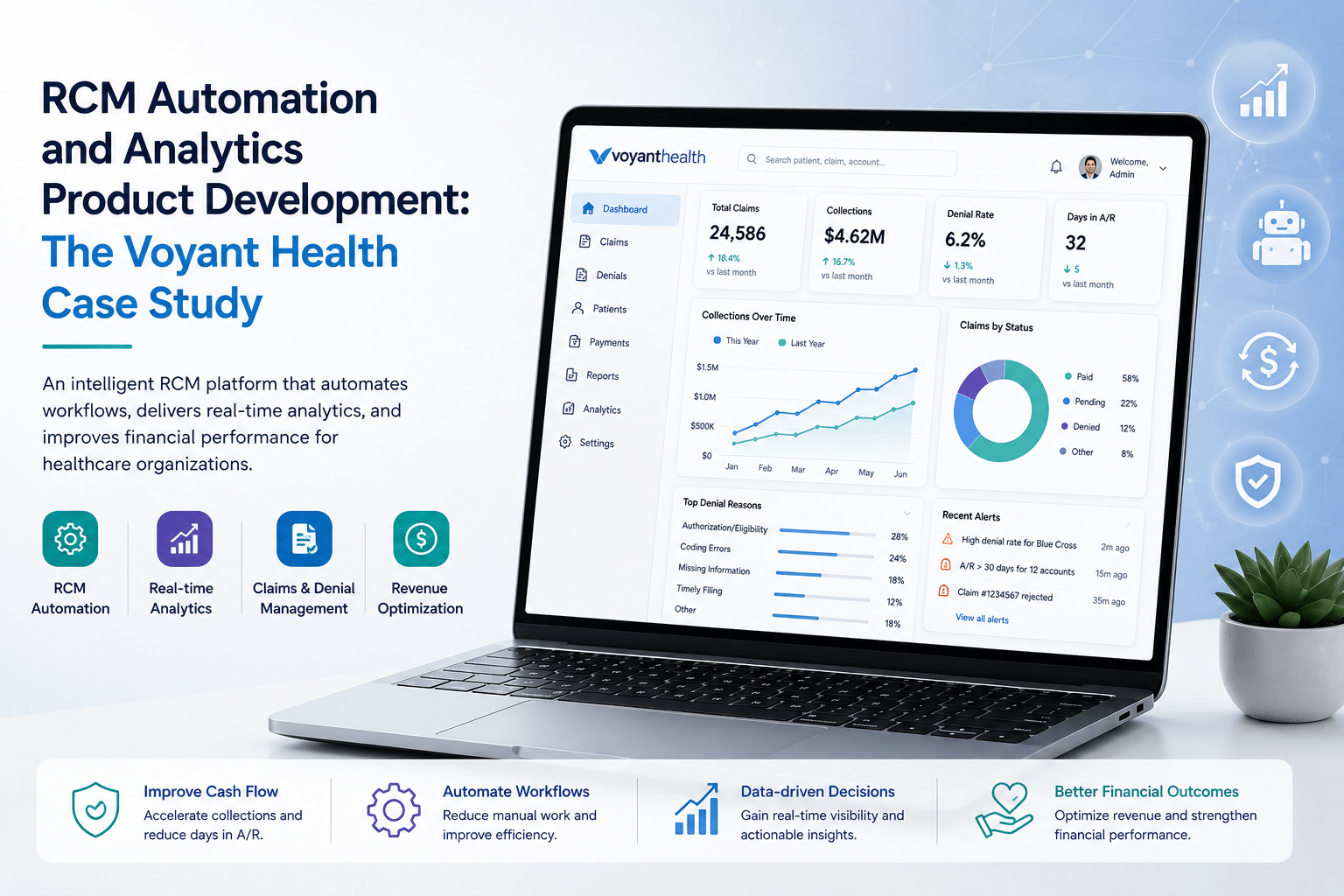
Taction Software built and launched a new product for Voyant Health, a Santa Monica-based group of RCM consultants delivering technology solutions that enhance revenue cycles for healthcare providers and medical billing companies. Voyant’s technology practice covers automation, workflow, data, and advanced analytics, with automation applied to repetitive revenue cycle tasks including data extraction, eligibility and benefits checks, payment posting, and records retrieval. The product launched on schedule.
Quick Results
| Outcome | Detail |
| Delivery | Launched on time, against a go-to-market date rather than an internal deadline |
| Product scope | Automation and analytics supporting revenue cycle operations |
| Automation targets | Data extraction, eligibility and benefits verification, payment posting, records retrieval |
| System compatibility | Works across the major EHR and practice management systems Voyant’s clients run |
| Client outcome | Product supports Voyant’s evolving business strategy and market position |
| Client audience served | Medical billing and RCM companies, provider executives and owners, private equity and institutional investors |
“Taction has proved their expertise in timely project delivery and this helped us to a successful on-time launch. Our new product can now truly support our evolving business strategy to remain at the forefront of our sector.”
Sean McSweeney, Chief Advisory Officer, Voyant Health
Book a 30-minute build assessment
Client Overview
Voyant Health is a group of RCM consultants delivering growth and technology solutions that enhance revenue cycles and optimize processes for healthcare providers and medical billing companies. The team combines marketing and sales professionals, data scientists, engineers, and revenue cycle leaders.
The firm’s origin explains its product requirements. Voyant’s founders previously built and ran a large national medical billing company, Cobalt Health, which merged in a private-equity-backed roll-up and eventually became Coronis Health. The technology they had built to solve their own billing problems became the basis for helping other billing companies solve the same ones.
Chief Advisory Officer Sean McSweeney brings that operating history plus prior roles at 4medica, Toshiba Medical, and GE Healthcare. Voyant’s work has been featured in HFMA, Medical Economics, Becker’s, and Modern Healthcare.
Voyant serves three audiences: medical billing and RCM businesses, executives and owners of healthcare providers, and private equity and institutional investors. Taction Software was engaged to build the product behind Voyant’s technology solutions practice.
The Challenge
Revenue cycle management runs on repetitive work. Someone extracts data from a payer portal. Someone checks eligibility and benefits. Someone posts a payment. Someone requests records. Multiply that across thousands of claims and the labor cost defines the margin of the entire business.
Voyant needed a product that addressed four constraints at once.
Labor cost as the binding constraint. Billing companies compete on cost per claim. Every task performed by a person rather than a system is margin that competitors with better automation will take.
Staffing gaps that will not close. Certain revenue cycle functions are persistently hard to staff. Automation has to fill those gaps reliably, because a program that only works when fully staffed does not solve the problem it was bought to solve.
Heterogeneous client systems. Voyant’s clients run different EHR and practice management platforms. A product that only works against one system is a feature, not a business.
Analytics that drive decisions, not reports. Benchmarking, KPI development, operational performance targets, and performance monitoring only matter if the underlying data is trustworthy and current. Analytics on stale or inconsistent data produces confident wrong answers.
And a fifth constraint that shaped delivery more than any of the others: the launch date was a commercial commitment. Voyant is a consulting firm whose credibility rests on delivering results for clients. A product that slips does not just miss a date, it undermines the positioning the product exists to support.
Our Solution
An automation and analytics product built for the specific repetitive tasks that consume revenue cycle labor, designed to operate across the range of EHR and practice management systems Voyant’s clients already run.
Automation handles the high-volume, low-judgment work: extracting data, verifying eligibility and benefits, posting payments, and retrieving records. The analytics layer sits on the resulting data, supporting KPI development, performance target setting, and ongoing monitoring. This is the same territory as our medical billing software development practice.
Implementation and Approach
Requirements from operators, not from a spec. Voyant’s team had run a national billing company. The requirements came from people who had performed the work being automated, which removes the usual discovery risk of building automation for a process nobody on the project has actually done.
Automation scoped to task, not to process. Rather than attempt end-to-end process automation, individual repetitive tasks were targeted. Task-level automation deploys faster, fails more safely, and produces measurable results sooner than a process-wide rebuild.
Multi-system compatibility designed in. Because client organizations run different EHR and practice management systems, the product was built to work across them rather than against a single integration target. Our healthcare integration and interoperability practice handles this class of problem.
Analytics on a consolidated data layer. Benchmarking and KPI monitoring were built on the data automation produces, so metrics reflect current operations rather than periodic manual exports.
Compliance treated structurally. Revenue cycle automation touches protected health information at every step. Encryption in transit and at rest, access control, and audit logging follow the standard we apply across HIPAA-compliant software development.
Delivery managed to the launch date. The date was fixed and commercial. Scope was sequenced so the launch-critical path stayed protected, which is why the product shipped on time.
Technology Stack
| Layer | Requirement it had to satisfy |
| Automation layer | Scripted task automation deployable quickly against payer portals and client systems |
| Data layer | Consolidation of extracted revenue cycle data into a queryable, analytics-ready store |
| Analytics layer | KPI definition, performance target tracking, and ongoing monitoring |
| Integration layer | Compatibility across the major EHR and practice management systems in Voyant’s client base |
| Security | Encryption in transit and at rest, role-based access control, audit logging |
Insert the actual technologies before publishing. Every other case study in this set names its stack off the portfolio slide, and prospects evaluating a build partner read the stack table closely. I have described what each layer had to do rather than name technologies I cannot verify, because a wrong stack on a live case study is worse than an incomplete one. Ask the delivery team for the four or five you actually used.
Key Features
Automated data extraction. Pulling revenue cycle data from payer portals and client systems without manual retrieval.
Automated eligibility and benefits verification. One of the highest-volume repetitive checks in the revenue cycle, handled by the system.
Automated payment posting. Removing a task that is both high-volume and error-prone when performed manually.
Automated records retrieval. Obtaining the documentation claims and appeals depend on.
Advanced analytics. Reporting and analysis on consolidated revenue cycle data.
Benchmarking and KPI monitoring. KPI development, operational performance target setting, and ongoing performance monitoring.
Multi-system operation. Functioning across the major EHR and practice management platforms Voyant’s clients run.
Results and Business Impact
On-time launch. The product shipped to schedule, which is the outcome the client named. For a firm whose market position depends on delivering results, a launch that holds is not a project metric, it is a commercial one.
Labor cost addressed at the task level. Automation of extraction, eligibility checks, payment posting, and records retrieval targets the specific work that drives cost per claim in a billing operation.
Staffing gaps covered by the system. Functions that are hard to staff are handled by automation, freeing staff for higher-judgment work rather than leaving the gap open.
Analytics on live operational data. Benchmarking and KPI monitoring run on data the automation produces, so performance targets are measured against current reality.
A product that supports the client’s strategy. Voyant sells technology-enabled revenue cycle consulting. The product is what makes that offer deliverable at scale rather than one engagement at a time.
See what your product build would take
Why Our Approach Worked
Delivery date treated as a requirement, not an estimate. When a launch date is a commercial commitment, protecting the critical path is the project’s primary constraint. Scope sequencing, not optimism, is what makes dates hold.
Task-level automation over process-level ambition. Automating four specific high-volume tasks well beats automating a whole process partially. It also produces measurable results inside the first release.
Revenue cycle domain depth. Taction Software has built healthcare revenue cycle software since 2013, and our CEO brings 20 or more years of personal experience in the space. Eligibility verification quirks, payment posting edge cases, and payer portal variability were known problems rather than mid-build discoveries. Our broader healthcare software development practice is built around that depth.
Multi-system compatibility from the start. Building for one system and generalizing later is how automation products become unsellable. Designing for heterogeneity up front cost more early and less overall.
Comparable work in the portfolio. Other healthcare platform builds include Coronis Health, Procentive, Rhythm, and Xoomia. Engagements like this are staffed the way we staff a dedicated healthcare development team.
Investment Ranges
| Scope | Investment |
| MVP: two to three automation targets, basic reporting | $40,000 to $80,000 |
| Full product: multi-task automation, analytics layer, multi-system compatibility | $80,000 to $200,000 |
| Enterprise: high transaction volume, extensive payer and system coverage, advanced analytics | $200,000 and up |
Where a project lands depends on the number of automation targets, how many client systems must be supported, and analytics complexity.
Related Services
- Medical billing software development
- Healthcare integrations and interoperability
- HIPAA-compliant software development
- Healthcare software solutions
- Healthcare software development services
- Dedicated healthcare development team
Frequently Asked Questions
What is RCM automation?
Software that performs repetitive revenue cycle tasks without manual effort, typically data extraction, eligibility and benefits verification, payment posting, and records retrieval. These are the highest-volume, lowest-judgment tasks in a billing operation, which makes them where automation returns the most.
Why automate tasks rather than whole processes?
Task-level automation deploys faster, produces measurable results in the first release, and fails safely. Process-level automation projects take longer to show value and carry more risk if requirements shift mid-build.
Can RCM automation work across different EHR and practice management systems?
It has to, if the product serves clients rather than one organization. Multi-system compatibility is a design decision made at the start, because retrofitting it means rebuilding the integration layer.
How does automation help with staffing shortages?
Certain revenue cycle functions are persistently hard to staff. Automation handles those consistently, and frees existing staff for work that requires judgment.
Is RCM automation HIPAA compliant?
It must be. Automation touches protected health information at every step, so encryption, role-based access control, and audit logging are structural requirements. Full compliance also depends on your internal policies and business associate agreements, which we help scope.
How long does an RCM automation product build take?
An MVP covering two or three automation targets typically runs three to five months. Timeline scales with the number of automation targets and client systems in scope.
Can you deliver against a fixed launch date?
Yes, and that is what this engagement demonstrates. Fixed dates require scope sequencing decided up front, with the launch-critical path protected. Bring the date to the scoping call and we will tell you what fits inside it.
Who owns the code?
You do.
Ready to Build a Product Against a Real Launch Date
If your revenue cycle operation is carrying labor cost on repetitive work, or you are building a product your commercial strategy depends on, the constraint is usually delivery rather than concept. We will scope the build and tell you what fits inside your date.